LTE handovers are controlled by measurement events that tell the UE when to trigger a handover to another cell. The events are defined in 3GPP specifications and are used for intra‑LTE and inter‑RAT (Radio Access Technology) handovers.
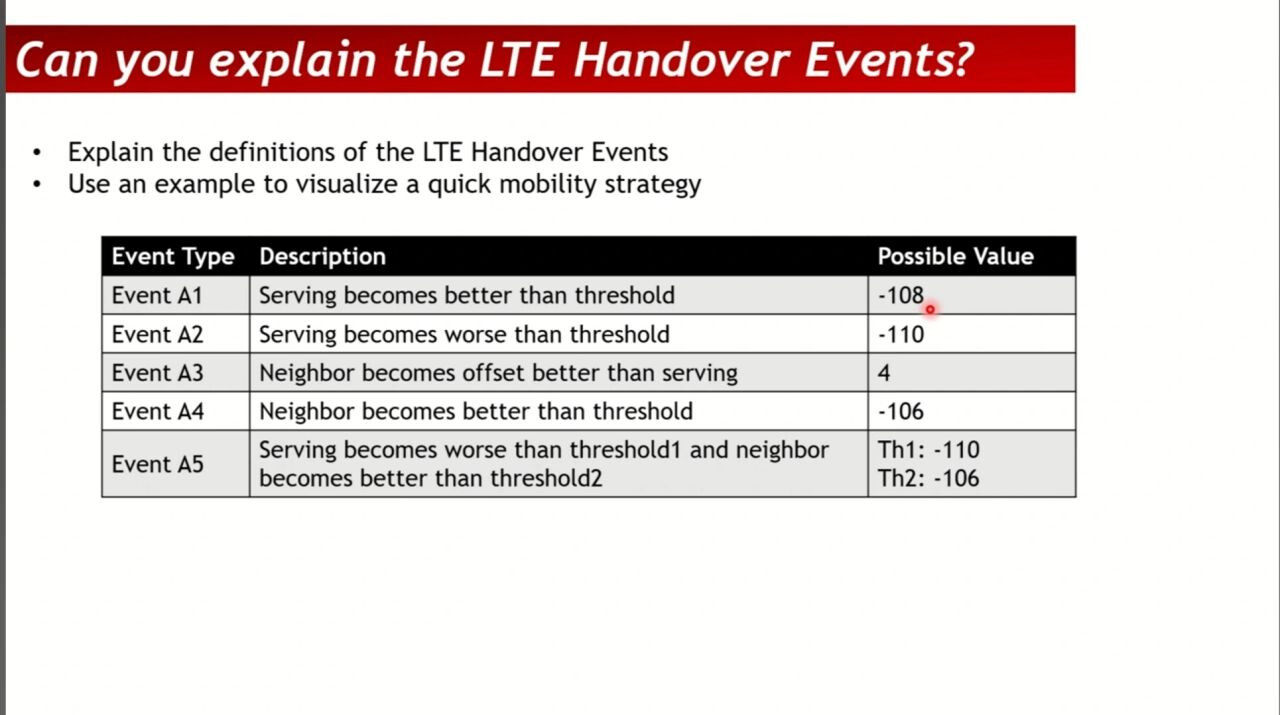
Event A1 – Serving cell becomes better than threshold
Description: The signal quality/strength of the serving cell rises above a configured threshold, indicating good coverage.
Example: A mobile moving into the center of a cell measures RSRP > −108 dBm (threshold). The UE reports the event, and the network may decide to keep the UE in the same cell or optimize resources.
Trigger: First event when coverage improves significantly.
Event A2 – Serving cell becomes worse than threshold
Description: The serving cell’s signal drops below a threshold, signalling deteriorating coverage and the need to search for a better cell.
Example: RSRP falls below −110 dBm. The UE reports A2, initiating a search for neighbor cells for potential handover.
Trigger: Usually triggered after A1 if conditions degrade; it starts the handover preparation phase.
Event A3 – Neighbor cell becomes offset better than serving cell
Description: A neighbor cell’s signal is better than the serving cell by a configured offset, indicating a better candidate for handover.
Example: Neighbor RSRP is 4 dB stronger than the serving cell (after applying an offset). The UE reports A3, prompting the network to consider handover to that neighbor.
Trigger: Follows A2 when a suitable neighbor is found; it decides which cell to hand over to.
Event A4 – Neighbor cell becomes better than threshold
Description: A neighbor cell’s signal exceeds a specific threshold, making it a strong candidate even without comparing to the serving cell.
Example: Neighbor RSRP > −106 dBm. The UE reports A4, informing the network of a strong neighbor for potential load balancing or handover.
Trigger: Can be triggered independently of A2/A3, often used for load balancing.
Event A5 – Serving worse than threshold1 & neighbor better than threshold2
Description: Two conditions must be met: the serving cell falls below threshold1 and a neighbor exceeds threshold2, triggering a handover.
Example: Serving RSRP < −110 dBm (Th1) and neighbor RSRP > −106 dBm (Th2). The UE reports A5, forcing a handover to the neighbor.
Trigger: Typically the final event leading to an actual handover execution, combining A2 and A4 conditions.
LTE handovers rely on measurement events (A1–A5) defined by 3GPP to decide when a UE should stay on the serving cell or move to a better neighbor. A1 confirms good coverage, A2 signals degradation, A3 compares neighbor strength with an offset, A4 flags a strong neighbor, and A5 combines serving degradation with neighbor superiority to trigger execution.
LTE handover events (A1–A5 & B1–B2) are predefined measurement triggers that help a mobile device (UE) decide when and to which cell it should hand over while moving in a 4G LTE network. These events are configured according to 3GPP standards and are essential for smooth mobility without call drops or data interruption.
Event A1: Occurs when the serving cell’s signal quality improves beyond a configured threshold — indicating good coverage.
Event A2: Triggered when the serving cell’s signal falls below a threshold, prompting the UE to look for better neighbors.
Event A3: Happens when a neighbor cell’s signal becomes better (by a specified offset) than the current serving cell, often initiating a handover.
Event A4: Indicates a neighbor cell’s signal exceeds a threshold and can be a candidate for mobility or load balancing.
Event A5: A dual condition where the serving cell weakens and a neighbor cell strengthens above their respective thresholds, typically leading to the actual handover execution.
Event B1 & B2: Used for inter-technology or inter-RAT handovers (e.g., from LTE to another RAT like 3G or Wi-Fi), based on neighbor signal thresholds and simultaneous serving cell degradation.
These events allow the network to intelligently decide handovers based on signal measurements, helping maintain seamless connectivity and optimal network performance.
Here’s a video for a clearer visual explanation of LTE measurement and handover events: LTE Events: Measurements Reporting (A1–A5 & B1–B2) — https://www.youtube.com/watch?v=ExBniNo5X3U

 LTE Events: Measurements Reporting (A1–A5 & B1–B2) —