AI and Automation Become Part of the Daily Routine for Telecom, Technology, and Innovation Professionals
The profile of technology users is changing rapidly.
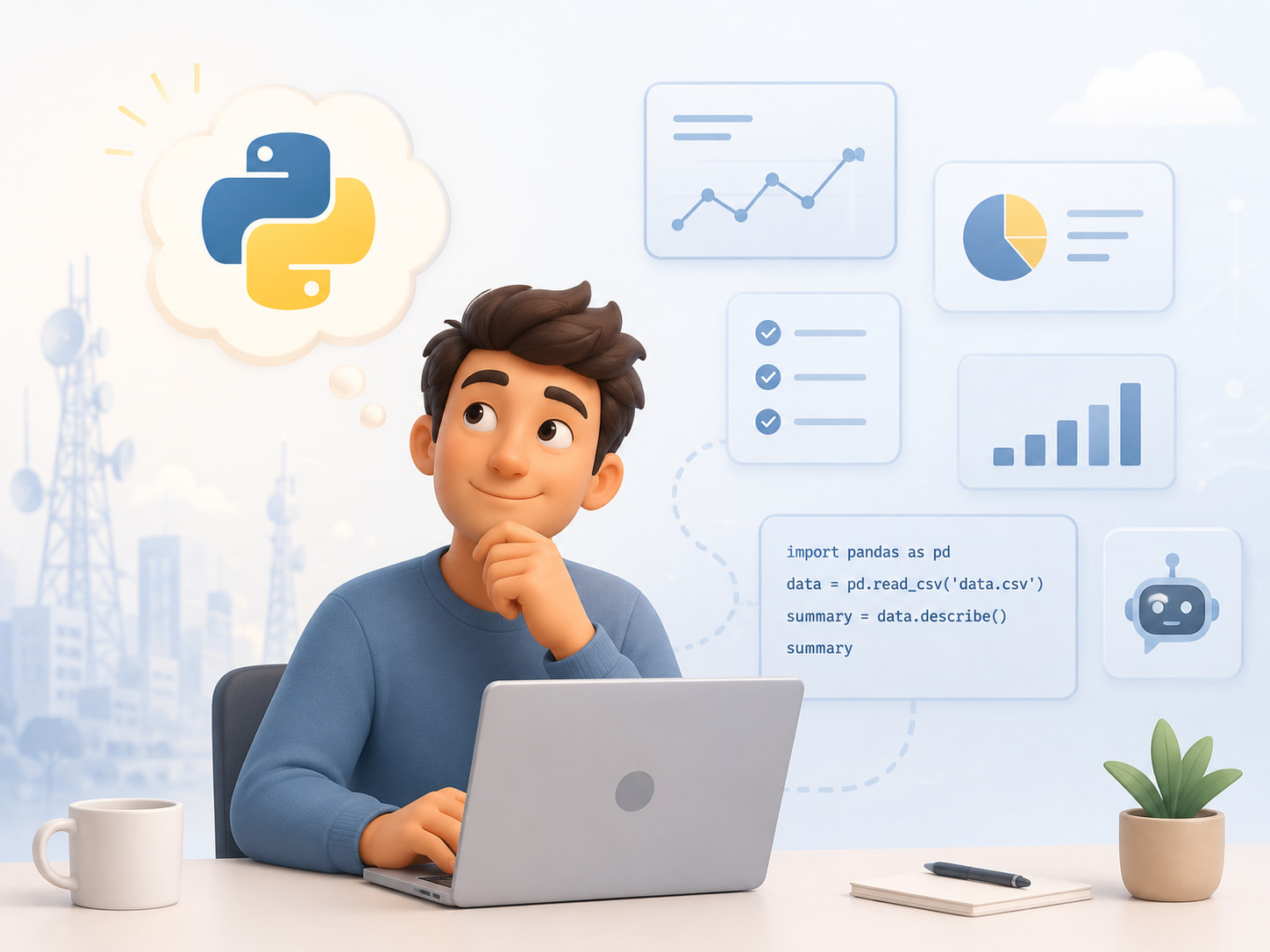
For many years, programming, automation, and software development were activities reserved for specialists. Today, professionals in telecommunications, operations, engineering, innovation, management, and corporate functions are incorporating artificial intelligence into their daily routines- even if they have never written a single line of code.
Tools such as ChatGPT, Claude, Gemini, and other large language model (LLM)-based solutions are enabling professionals from diverse backgrounds to automate tasks, organize information, generate analyses, create reports, and improve productivity using nothing more than natural language.
The result is a quiet but profound transformation in how work gets done.
From Programming to Problem Solving
The profile of those learning automation and leveraging technologies like Python has also evolved.
For years, Python was viewed primarily as a tool for software developers. Today, it is increasingly becoming part of the toolkit of professionals working in telecommunications, technology, operations, and innovation.
For many specialists, a basic understanding of automation and data analysis is becoming valuable in roles that, until recently, had little or no connection to programming.
The goal is no longer necessarily to become a professional developer, but rather to use technology to solve problems, eliminate repetitive tasks, and improve efficiency.
What AI Can Do That Traditional Tools Cannot
Spreadsheets, enterprise systems, and conventional software remain essential, but they often reach their limits when information volumes grow or repetitive activities consume a significant portion of a team’s time.
With the support of AI, professionals can:
- Summarize technical documents;
- Analyze logs and alarms;
- Generate reports automatically;
- Create presentations;
- Organize scattered information;
- Produce technical documentation;
- Interpret operational data;
- Build scripts and automations on demand;
- Accelerate analysis and decision-making.
Tasks that previously required hours or even days can now be completed in minutes, allowing professionals to focus on activities that truly create business value.
Telecom and Technology Are Among the Most Impacted Industries
In telecommunications, engineers, mobile network specialists, operations teams, RF engineers, Core network professionals, Transport engineers, OSS/BSS specialists, and infrastructure experts are already using AI to support activities that once required extensive manual work, research, or custom development.
The combination of domain expertise and AI tools enables faster troubleshooting, KPI analysis, specification reviews, documentation generation, configuration comparisons, and even the creation of simple automations without prior programming experience.
The same trend can be seen across technology, innovation, operations, and management functions.
Competitive advantage is no longer defined solely by technical expertise. Increasingly, it comes from the ability to leverage artificial intelligence to amplify results.
Learning Has Never Been More Accessible
A few years ago, learning programming or automation typically required formal training, specialized courses, and a significant learning curve.
Today, the reality is very different.
AI models themselves have become learning tools, enabling professionals to understand concepts, create automations, learn coding fundamentals, and build practical solutions directly tied to their day-to-day challenges.
At the same time, professional communities are playing an increasingly important role in this transformation.
Collaborative communities such as TelecomHall bring together professionals from different companies, technologies, and experience levels to share knowledge, discuss real-world challenges, exchange best practices, and accelerate collective learning.
The combination of AI-powered learning and specialized communities has dramatically lowered the barriers to acquiring new skills.
The Rise of the Augmented Professional
More than learning a specific programming language or becoming a software developer, the emerging trend is to use artificial intelligence as an extension of one’s professional capabilities.
We are entering an era where the most productive professionals will not necessarily be those who write the best code, but those who can combine practical experience, domain expertise, critical thinking, and AI tools to solve problems faster and more effectively.
Technology is no longer a specialized discipline confined to technical teams. It is becoming a universal capability that spans virtually every function within modern organizations.
For many professionals in telecommunications, technology, and innovation, the future has already arrived - and it is being shaped by people who may never have considered themselves programmers, yet have learned how to use AI to dramatically expand what they can accomplish.