 If a car is browsing the internet or using standard protocols like HTTP/TCP, the session disconnects immediately when the IP changes, and a new connection must be established.
 This behavior is not suitable for IoT car applications, which require real-time, continuous connectivity.
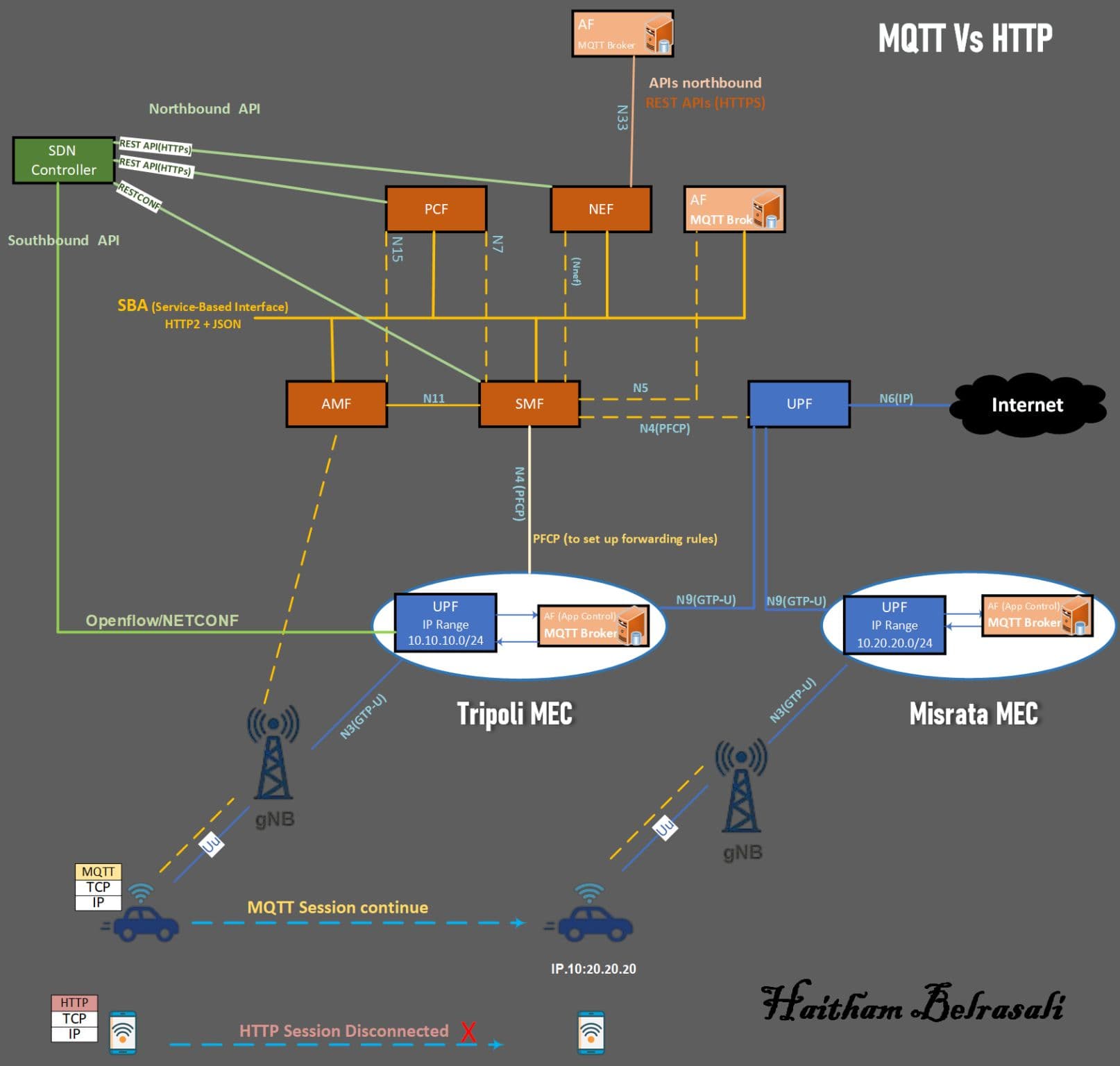
 What happens in 5G networks when moving from MEC1 (Tripoli) to MEC2 (Misrata)?
If the car is browsing the internet (HTTP / HTTPS), it relies on standard TCP/IP.
When moving from MEC-1 to MEC-2, the following happens 

 At the 5G Core level:
• The network detects that the car has left the first MEC area.
• The SMF redirects the session to a new UPF in MEC-2 (Handover).
• In some cases — especially inter-UPF handovers — the car’s IP address changes.
 What happens to the current session?
If the IP changes during browsing:
• The ongoing TCP session is terminated immediately.
• The browser or app must create a new connection.
• As a result:
 You may notice a temporary page freeze
Or an automatic page refresh
Reason: The TCP protocol binds the session to a specific IP and port.
If the IP changes, the session is considered completely new and cannot resume.
Summary:
• During Intra-UPF Handover, the IP does not change, so the browsing session continues normally.
• During Inter-UPF Handover (moving between MECs), the IP changes, causing the TCP session to break and restart.
 This behavior is unsuitable for IoT car applications, which require uninterrupted real-time data transmission.
 This is where MQTT becomes essential!
MQTT operates at the Application Layer, meaning the session does not depend on IP but on the Client ID.
It automatically reconnects to the broker after an IP change and ensures reliable message delivery using QoS mechanisms.
 In MQTT:
• The client does not communicate directly with other clients — it connects to a Broker.
• The client identifies itself using a Client ID, not an IP address.
• The Broker maintains the session even if the client’s IP changes.
• Although MQTT uses TCP for transport, connection management is based on Client ID, not IP.
 Practical Example:
A car connected to a 5G network sends telemetry data to an MQTT Broker:
The car connects to the broker (e.g., mqtt.example.com).
It identifies itself with Client ID = Car123.
 When the car moves from MEC1 to MEC2 and its IP changes,
it reconnects to the same broker with the same Client ID.
 The broker recognizes it as the same client and keeps the session active (thanks to Session Persistence).
LinkedIn: