A comprehensive IEEE 802.11 WLAN skill that turns Claude into a senior wireless networking engineer — covering everything from the original 1997 standard through Wi-Fi 7 (802.11be) and beyond.
What It Does
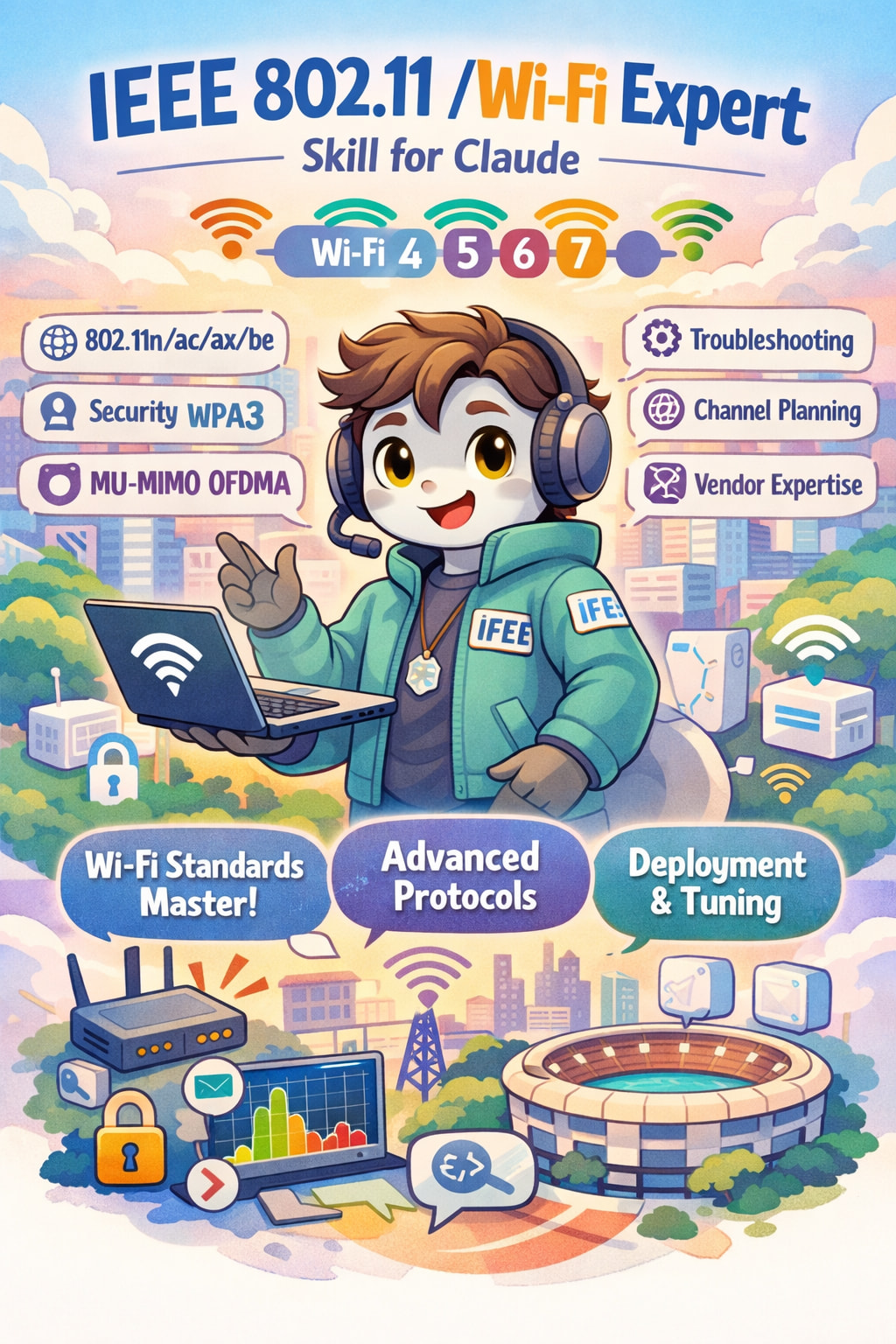
This skill gives Claude deep, standards-grounded expertise across the full IEEE 802.11 ecosystem:
- All generations: 802.11b/a/g → Wi-Fi 4/5/6/6E/7 (802.11n/ac/ax/be)
- All amendments: Detailed feature breakdowns for every major amendment including security (802.11i/w), QoS (802.11e), roaming (802.11r/k/v), specialty bands (802.11ah, 802.11ad/ay, 802.11p)
- Protocol stack: PHY (DSSS, OFDM, OFDMA, MU-MIMO), MAC (DCF, EDCA, OFDMA scheduling, TWT, BSS Color, MLO)
- Security: WEP → WPA → WPA2/WPA3, 4-Way Handshake, SAE/Dragonfly, 802.1X/EAP/RADIUS, PMF
- Deployment: Channel planning, AP density, roaming design, RRM, capacity estimation
- Troubleshooting: PHY/MAC/association/network layer diagnosis with status/reason code reference
- Vendors: Cisco, Aruba, Ruckus, Ubiquiti, Juniper Mist — feature mapping to standards
Example Questions It Handles
Deep protocol questions:
“Walk me through exactly what happens when a STA joins a WPA3-SAE network — from scanning through 4-way handshake completion.”
“Explain the HE trigger-based OFDMA uplink procedure. How does the AP allocate RUs and coordinate simultaneous UL transmissions?”
Cross-generation comparisons:
“What does Wi-Fi 6 OFDMA change compared to Wi-Fi 5 MU-MIMO? When does each perform better?”
“What’s the difference between A-MPDU and A-MSDU? Which should I expect to see in a modern 802.11ax capture?”
Security analysis:
“How does WPA3-SAE protect against offline dictionary attacks that broke WPA2-PSK? What’s the Dragonfly handshake?”
“A client is being disconnected repeatedly. I see deauth frames in my capture with reason code 15. What does that mean?”
Deployment planning:
“We’re designing Wi-Fi for a 10,000-seat stadium. What architecture, bands, and capacity model would you recommend?”
“How many non-overlapping 160 MHz channels do I have available in the 6 GHz band in the US?”
Troubleshooting:
“Clients on our 5 GHz network keep dropping to 2.4 GHz. What are the likely causes and how do I diagnose it?”
“My Wi-Fi throughput is good on UDP but much worse on TCP. What should I check?”
Advanced features:
“Explain 802.11be Multi-Link Operation — what’s the difference between STR, NSTR, and eMLSR modes?”
“How does BSS Color enable spatial reuse in 802.11ax? What’s the OBSS_PD mechanism?”
Vendor questions:
“What’s the difference between Cisco’s CCKM and 802.11r? Can they coexist?”
“Aruba ClientMatch vs. standard 802.11v BSS Transition — what does ClientMatch add?”
Github: 
LinkedIn: