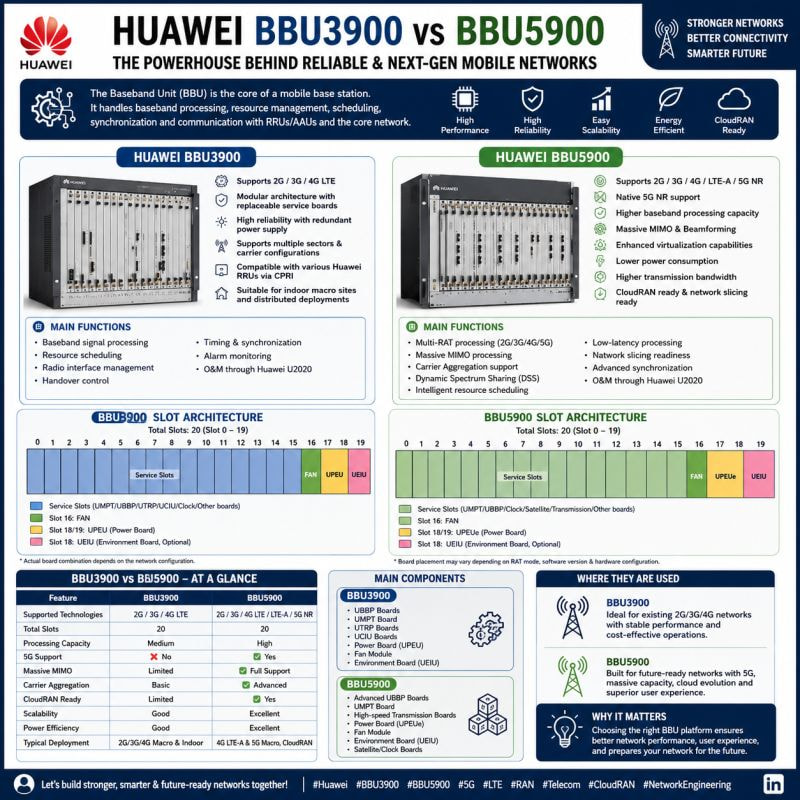
The Baseband Unit (BBU) is the heart of a cellular base station. It performs baseband processing, radio resource management, scheduling, synchronization, and communication with the RRUs/AAUs. Huawei’s BBU3900 and BBU5900 are among the most widely deployed BBUs in modern mobile networks.
 Huawei BBU3900
The BBU3900 is designed for 2G, 3G, and 4G LTE networks and has been widely used in macro and indoor deployments.
Specifications
• Supports GSM, UMTS, and LTE
• Supports CPRI connectivity with RRUs
• Modular architecture
• Hot-swappable service boards
• Centralized O&M through Huawei U2020
Slot Architecture
 Total slots: 20 (Slot 0–19)
Typical fixed slots:
- Slot 16: FAN board
- Slot 18/19: UPEU (Power Board)
- Slot 18: UEIU (Environment Board, optional)
Remaining slots are used for:
- UMPT (Main Processing Board)
- UBBP (Baseband Processing Board)
- UTRP (Transmission Board)
- UCIU (Interconnection Board)
- Clock and expansion boards depending on network configuration.
Functions
 Baseband processing
Scheduling
Handover management
Synchronization
Alarm monitoring
Transmission management
Huawei BBU5900
The BBU5900 is Huawei’s next-generation platform supporting 2G, 3G, 4G LTE, LTE-A, and 5G NR with significantly higher processing capacity.
Specifications
• Native 5G support
• Massive MIMO support
• Carrier Aggregation
• CloudRAN Ready
• Lower power consumption
• Higher processing capability
• Network slicing support
Slot Architecture
Total slots: 20 (Slot 0–19)
Typical fixed slots:
- Slot 16: FAN board
- Slot 18/19: UPEUe Power Board
- Slot 18: UEIU Environment Board (optional)
Service slots accommodate:
- UMPT Main Control Board
- UBBP Baseband Boards
- Clock Boards
- Satellite Cards
- High-speed transmission modules
The exact slot assignment depends on the RAT (2G/3G/4G/5G) and configured board combination.
Functions
Multi-RAT processing
Massive MIMO
Beamforming
Carrier Aggregation
Dynamic Spectrum Sharing (DSS)
Intelligent scheduling
Low-latency processing
Centralized network management
 BBU3900 vs. BBU5900
Feature| BBU3900| BBU5900
Total Slots| 20| 20
Supported Technologies| 2G/3G/4G| 2G/3G/4G/5G
Processing Capacity| Medium| High
Massive MIMO| Limited| Full Support
5G Ready|  |
|
CloudRAN| Limited| Yes
Scalability| Good| Excellent
Power Efficiency| Good| Excellent
Understanding BBU hardware, slot assignments, and board configurations is essential for telecom professionals working in RAN, RF Optimization, Integration, and NOC Operations.
LinkedIn: 