Your phone never drops a call while moving at 100 km/h.
Ever wondered how? That’s 5G Handover working silently in the background. 
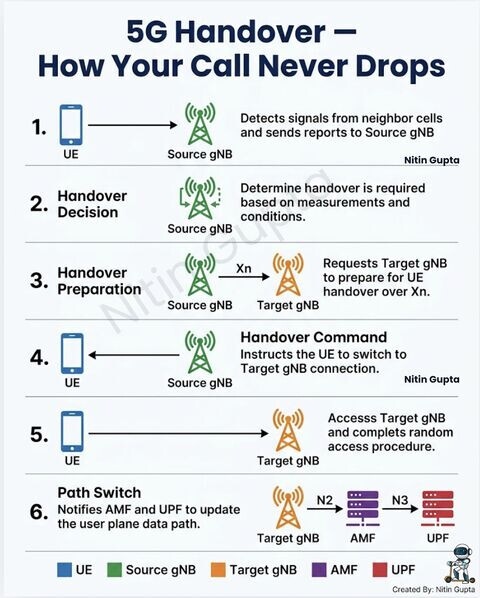
Here’s what happens in milliseconds — step by step:
-
Step 1 — Measurement Report Your UE constantly measures signal strength from nearby gNBs and reports the best candidate to the Source gNB.
-
Step 2 — Handover Decision The Source gNB analyses the report and decides: “Time to hand this UE over.”
-
Step 3 — Handover Request (Xn or N2) ▸ Xn Handover → Direct gNB-to-gNB (faster, no core involvement) ▸ N2 Handover → Via AMF in the 5G Core (used when Xn not available)
-
Step 4 — Handover Command UE receives the command: connect to the Target gNB now.
-
Step 5 — Random Access UE executes RACH on the Target gNB and syncs up.
-
Step 6 — Path Switch AMF updates the UPF. Your data path switches to the new gNB — seamlessly, without you noticing.
 Call intact. Video uninterrupted. You didn’t feel a thing.
This is why 5G handover is faster and smarter than 4G — because of better Xn interface design, lower latency, and tighter coordination between RAN and Core.
If you’re preparing for a 5G role — understanding handover is non-negotiable. 
 Which handover type have you worked on — Xn or N2? Drop it in the comments.
LinkedIn: 