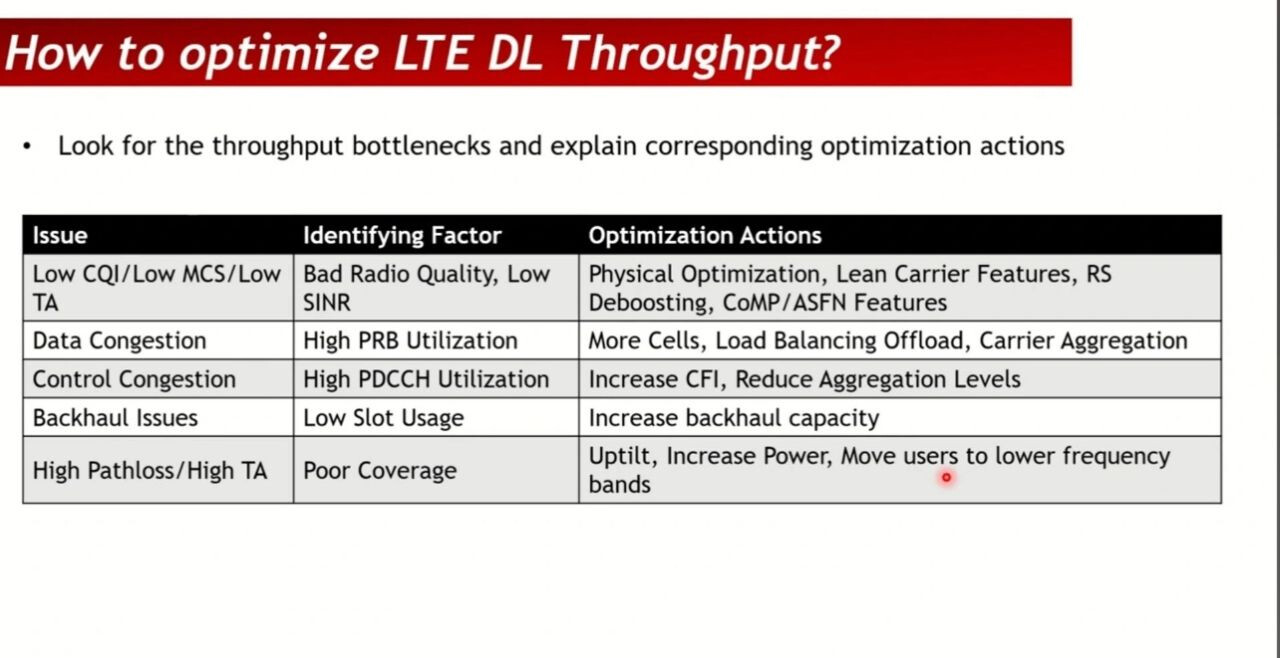
The goal is to identify throughput bottlenecks and apply corresponding optimization actions to improve LTE downlink (DL) performance.
Step 1: Low CQI / Low MCS / Low TA
Identifying Factor: Bad radio quality, low SINR
Optimization Actions:
- Physical optimization (antenna tilt, power adjustments)
- Enable Lean Carrier features to reduce overhead
- Use RS Deboosting to lower interference
- Activate CoMP or ASFN for coordinated signal improvement
CQI tells the network how good the signal is — low CQI means poor reception. MCS decides how fast data can be sent based on CQI; low MCS = slower throughput. TA indicates distance or timing issues. SINR affects everything — improving it lifts CQI → lifts MCS → boosts speed.
Example: In a crowded city with lots of interference, tweaking antenna angles + turning on CoMP can clean up the signal, raise CQI, and unlock higher speeds.
Step 2: Data Congestion
Identifying Factor: High PRB utilization
Optimization Actions:
- Add more cells to share the load
- Use load balancing to move users to less busy cells
- Enable Carrier Aggregation to combine multiple bands for more bandwidth
PRB = Physical Resource Block — the “airtime” each user gets. When PRBs are full, users wait. Adding capacity or shifting traffic fixes it.
Example: During a big event like a match or concert, adding small cells or turning on CA can instantly increase available bandwidth.
Step 3: Control Congestion
Identifying Factor: High PDCCH utilization
Optimization Actions:
- Increase CFI to give more space for control signals
- Reduce aggregation levels to free up control channel resources
PDCCH carries instructions to users — if it’s overloaded, no one gets told what to do. CFI controls how much space is reserved for control info. Reducing aggregation makes messages leaner.
Example: At peak times, bumping CFI from 2 to 3 opens up room for more scheduling — keeps things moving.
Step 4: Backhaul Issues
Identifying Factor: Low slot usage
Optimization Actions:
- Increase backhaul capacity (upgrade to fiber, add microwave links)
Backhaul is the pipe between the tower and the core network. If it’s choked, even if radio is perfect, data can’t flow fast.
Example: A site showing low slot usage likely has a backhaul bottleneck — upgrading it unlocks real throughput gains.
Step 5: High Pathloss / High TA
Identifying Factor: Poor coverage
Optimization Actions:
- Uptilt antennas to cover farther
- Increase transmit power where allowed
- Move users to lower frequency bands for better penetration
High pathloss = signal fades fast over distance or through buildings. High TA = user is far away. Fixing coverage brings users back into good signal zone.
Example: In rural areas, uptilting antennas or boosting power can extend reach — lowering TA and improving experience.
LinkedIn: 