Dear colleagues,
In the following post I refer to a high order QAM-4096 modem, that is about to serve in WI FI 7,8 standards, as the distance between the constellations gets smaller, the inevitable channel noise will more likely alter the transmitted constellation to a different one at the demodulator.
If a BER of <= 1e-5 is acceptable then for QAM orders of 16, 64, 256, 1024, 4096 the required Eb/N0 should be at least 13.5, 17, 23, 27, 33 db respectively, or in terms of symbol SNR 19.5, 24.8, 32, 37, 43.8 db respectively (about 3 db per each additional bit per symbol).
One way to improve is to use Gray code, which causes neighboring constellations to differ by only 1 bit out of 12, lowering BER by ~30% at the same SNR.
An additional measure being a part of future WI FI 7,8 is the soft Low-Density Parity-Check (LDPC) algorithm, defined by G,H matrices of size m1 X n1 (n1 > m1 > 12) such that mod(H * G.', 2) = 0, N sent bits are reshaped to produce N/n1 codewords of length n1 by multiplication by G, the codewords are again reshaped to 12 bits groups to suit QAM-4096 complex symbols.
The symbols are sent via the noisy channel, which might alter the constellation, the demodulator does not know the correct constellation, but computes the log-likelihood ratio (LLR) for any bit of each symbol, which is log(probability(bit = 1) / probability(bit = 0)) for that specific symbol, while only close symbols to that symbol affect the LLR, all values are scaled by multiplication by 0.31/sqrt(noise variance).
The demodulator uses the same symbols-to-bits map construction as the bits-to-symbols map construction used by the modulator and based on Gray code, larger absolute values for LLRs mean more confidence we have if the bit is 1 (negative value) or 0 (positive value).
The LLRs are reshaped to groups of size n1 that participate in an iterative soft LDPC algorithm, that uses the LLR values and the structure of H to produce n1 decoded bits for each codeword such that mod(H*(decoded bits),2) is all zeros, so the parity constraint of H,G plays a key role in BER improvements, for good enough SNR, more than 90% of the codewords need just 1 iteration, finally, the data bits are the first m1 bits from each n1 bits codeword.
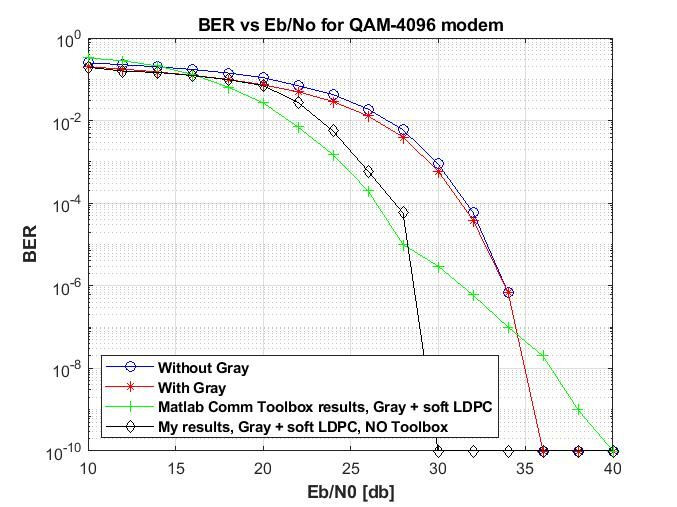
I demonstrate all the above by analyzing the BER performance of a QAM-4096 modem, with and without Gray code, and by adding a soft LDPC algorithm with H,G matrices of 48 X 96 elements (rate = 0.5), that produce codewords of 96 bits using G, then sent as 12-bits per symbol through a noisy channel, and demodulated using H to produce 48 bits messages from each 96 bit codeword.
The BER results are presented below, please note that that soft LDPC for these configuration improves the results only above Eb/N0 ~= 20 db (SNR = 30.8 db), better results should use larger G,H matrices, as will be shown in future posts, also using rate = 0.5 decreases the throughput by 50%, as half of the bits are used for parity check.
LinkedIn: 