Frequency Duplexing & Waveforms in 5G
As telecom engineers, we know the core challenge: the uplink (UL) and downlink (DL) can’t share the same frequency at the same time without causing interference.
Your phone sends to the tower (UL), while the tower sends to you (DL).
Running both simultaneously requires smart duplexing.
The Power Imbalance Problem
Base stations (BTS) have high transmit power → effective DL coverage.
Mobile devices have limited power → UL struggles with path loss.
Solution:
Assign lower frequencies to UL (e.g., 880–890 MHz) and higher frequencies to DL (e.g., 910–920 MHz).
Why?
Lower frequencies attenuate less, compensating for device power limits.
Balances UL | DL coverage (critical for cell-edge users).
The Duplexing Approaches: FDD vs TDD
FDD (Frequency Division Duplex)
 Separate dedicated frequencies for UL and DL.
Zero delay, continuous flow.
Ideal for voice & real-time apps.
Legacy in GSM networks.
TDD (Time Division Duplex)
Same frequency, alternating in time slots.
Dynamic allocation (e.g., 80% DL | 20% UL).
More spectrum-efficient.
The secret weapon of 5G.
TDD Weakness: Delay from propagation distance.
But in 5G: Reduced to <1 ms (vs ~100 ms in LTE).
The 5G NR Waveform Revolution
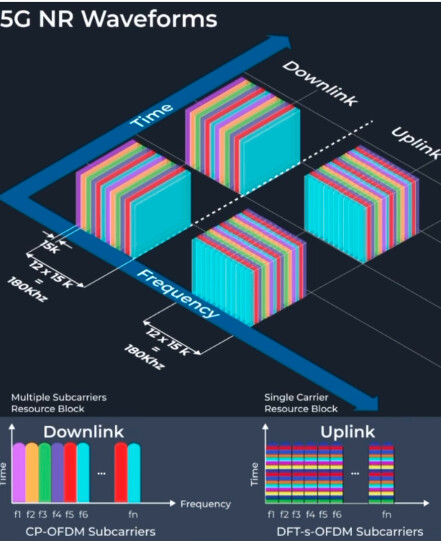
While 5G reuses LTE’s OFDM, it adds dynamic waveform intelligence:
 Downlink (DL): Always CP-OFDM → high throughput, multi-band support.
 Uplink (UL): Default DFT-s-OFDM → low PAPR for power-limited devices.
But if you’re near the tower, the network can switch UL to CP-OFDM for efficiency.
Goodbye LTE Rigidity:
5G networks dynamically control waveforms – one of NR’s superpowers.
Combining smart duplexing + adaptive waveforms in 5G enables:
90% spectrum utilization (vs ~90% in LTE with guard bands).
Ultra-reliable low-latency communications (URLLC).
Improved energy efficiency for IoT & devices.
Fellow engineers: How are you leveraging FDD/TDD hybrids in your 5G deployments? Share your field experiences.
LinkedIn: 