How does a 5G network decide which modulation scheme to use?
⠀
The network does not use the highest modulation order all the time.
⠀
It continuously balances radio-link reliability with data capacity.
⠀
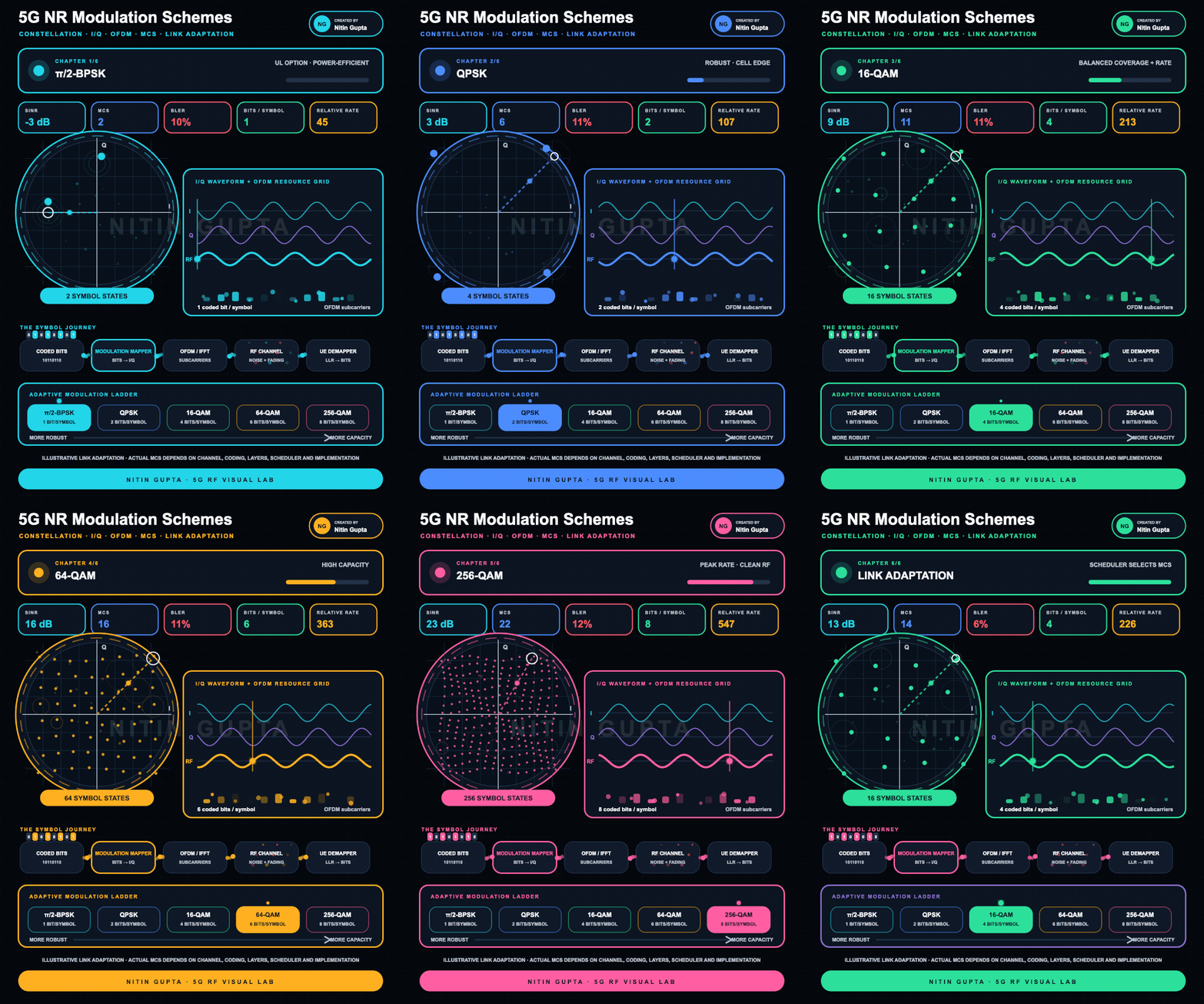
This animation follows the complete journey from coded bits to radio symbols.
⠀
01 — π/2-BPSK
⠀
π/2-BPSK can be used as an uplink option with transform precoding in applicable configurations.
⠀
It carries one coded bit per modulation symbol and supports power-efficient transmission under challenging radio conditions.
⠀
02 — QPSK
⠀
QPSK carries two coded bits per modulation symbol.
⠀
Its constellation points are widely separated, making it relatively robust against noise and interference.
⠀
It is commonly associated with difficult radio conditions, coverage-limited users and cell-edge operation.
⠀
03 — 16-QAM
⠀
16-QAM carries four coded bits per modulation symbol.
⠀
It provides a practical balance between robustness and capacity when the radio channel becomes cleaner.
⠀
04 — 64-QAM
⠀
64-QAM carries six coded bits per modulation symbol.
⠀
The constellation points are positioned closer together, so the receiver needs better signal quality to distinguish them reliably.
⠀
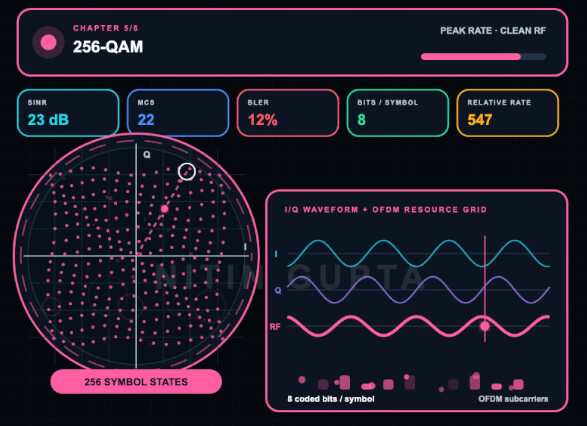
05 — 256-QAM
⠀
256-QAM carries eight coded bits per modulation symbol.
⠀
It provides higher spectral efficiency, but the dense constellation requires strong SINR, low distortion and accurate channel estimation.
⠀
FROM BITS TO RADIO SYMBOLS
⠀
The simplified processing journey is:
⠀
Coded bits
→ Modulation mapper
→ I/Q symbols
→ OFDM and IFFT processing
→ RF channel
→ UE demapper
→ Recovered bit information
⠀
The modulation mapper groups coded bits and converts them into complex I/Q constellation points.
⠀
These symbols are placed onto OFDM resource elements and transmitted across multiple orthogonal subcarriers.
⠀
The radio channel then introduces:
⠀
• Noise
• Interference
• Fading
• Phase errors
• Amplitude distortion
• Multipath propagation
⠀
At the receiver, the UE estimates the channel, evaluates the received constellation and calculates soft information for the channel decoder.
⠀
LINK ADAPTATION
⠀
The scheduler uses channel-quality information and implementation-specific algorithms to select an appropriate Modulation and Coding Scheme.
⠀
When radio quality improves:
⠀
• Higher-order modulation becomes possible
• More bits can be carried per symbol
• Spectral efficiency can increase
• User throughput can improve
⠀
When radio quality deteriorates:
⠀
• Constellation points become harder to distinguish
• Error probability increases
• BLER can rise
• Retransmissions may increase
• The scheduler selects a more robust MCS
⠀
The objective is not simply to maximize modulation order.
LinkedIn: 