By controlling the phase of the signals across its antenna elements.
⠀
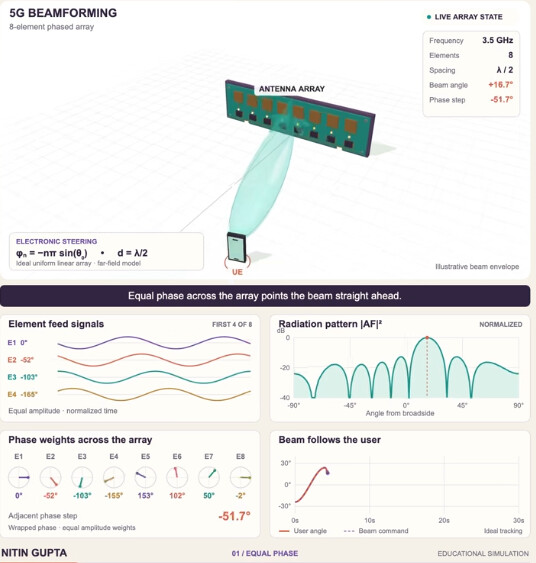
This animation visualizes the principle using an eight-element array. Watch the beam direction, feed signals, phase weights, and radiation pattern change together.
⠀
◆ What to watch in the video
⠀
● Equal phase → broadside beam
When all elements transmit with equal phase, their signals reinforce one another straight ahead, perpendicular to the array.
⠀
● Progressive phase → electronic steering
A phase step between neighboring elements shifts the direction in which the signals combine constructively.
⠀
● Updated weights → a moving beam
As the user changes direction, updating the phase weights steers the beam toward the new angle.
⠀
● Sidelobes remain
The radiation pattern shows a dominant main lobe and smaller sidelobes. Beamforming does not eliminate radiation in every other direction.
⠀
◆ A useful numerical example
⠀
With half-wavelength element spacing, steering to 30° requires a 90° phase-step magnitude between adjacent elements.
⠀
The animation uses an ideal, uniformly excited array with perfect tracking. It illustrates the underlying principle; it is not a measurement of commercial 5G equipment.
⠀
The key idea: coordinated phase controls where the signals reinforce each other.
LinkedIn: 