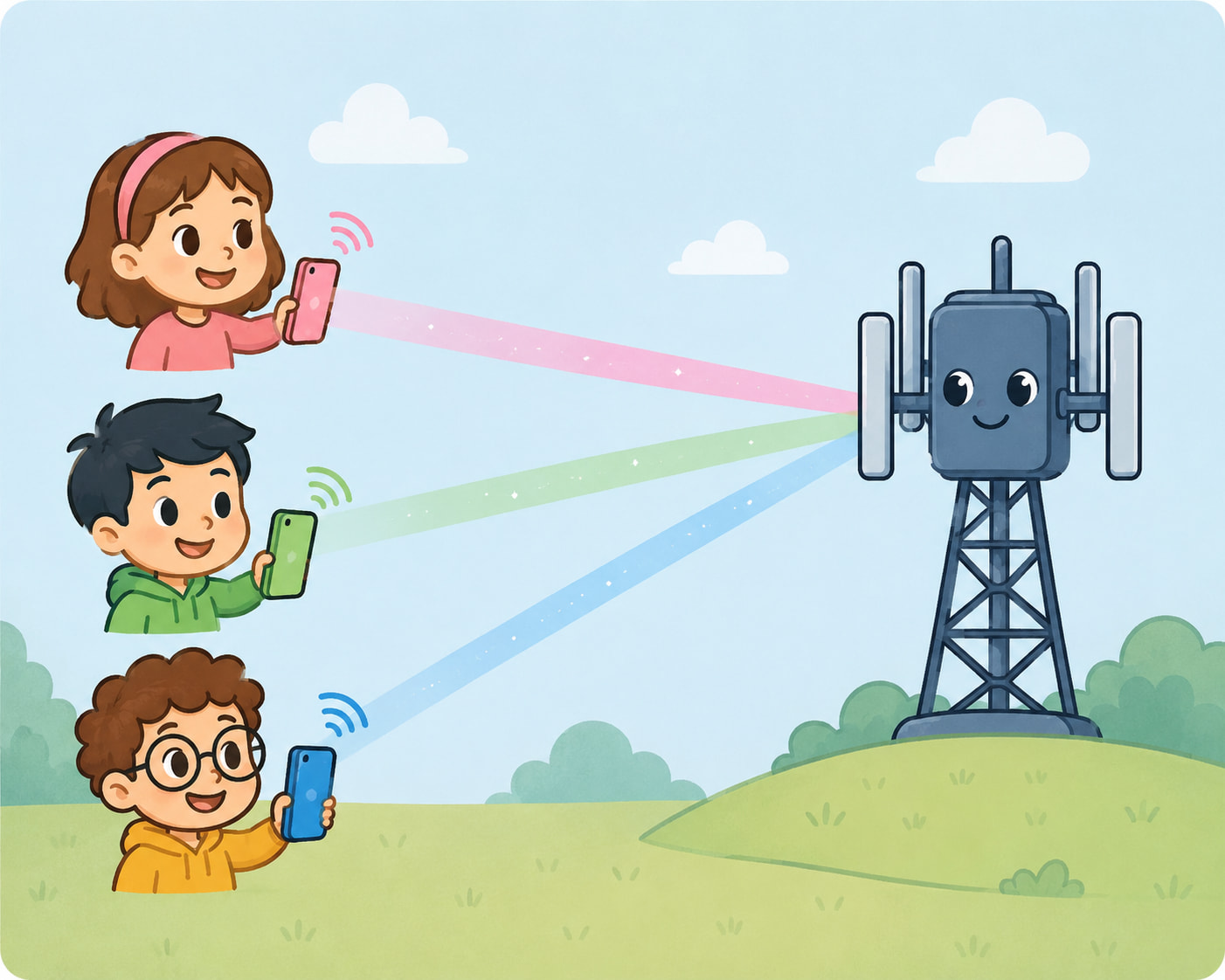
Hello.
Does anyone have knowledge about UL MU MIMO?
Is it deployed? And if yes does usually separate ue in fdm?
In other words: how are UE multiplexed when implementing UL MU MIMO?
For UL MU-MIMO UE will come in pairing if they are orthogonal.
Here single layer per UE used i.e. for 8 UE it’s 8 layer.
If UE come in pairing then eNB allocate same PRB to UE i.e. PRB multiplexing used.
But ratio of UE very less in pairing for Uplink.
Other conditions used UL SINR, PRB usage for UE in pairing in Uplink.
So 2 or more UE can transmit in same PRB same time?
What do you mean here by UEs are orthogonal?
Yes if UE’s come in pairing.
It means UE are spatially separated, so correlation < 1.
Hi all here is an explanation of how Ul-MIMO works based on Gemini AI answer:
how MU-MIMO works in uplink? In DL is easy to understand since each UE is in a different beam but in uplink gNodeB antenna would be in same beam for each UE, so how come they do not interfere each other?
The secret lies in a common misunderstanding: uplink MU-MIMO does not rely on pointing individual, tight physical beams at each user.
Instead, the gNodeB uses its multi-antenna array to receive all overlapping user signals simultaneously on the exact same time-frequency resources and uses digital spatial filtering (advanced signal processing) to separate them.
Here is how Uplink (UL) MU-MIMO resolves the interference problem without needing distinct receiving beams for each User Equipment (UE):
Even if two UEs are physically close and fall under the broad coverage footprint of the same gNodeB panel, their radio waves travel along slightly different multipath routes (reflecting off buildings, terrain, or indoor walls).
Each UE’s signal arrives at the N receiving antennas of the gNodeB with a unique combination of phase shifts and amplitude differences.
This unique spatial signature is captured in a Channel Matrix (H).
As long as the channel vectors of UE 1 (h1) and UE 2 (h2) are linearly independent (i.e., spatially orthogonal or nearly orthogonal), the gNodeB can distinguish between them.
Before transmission, each UE sends a Sounding Reference Signal (SRS) on known resources.
The gNodeB measures the SRS from every scheduled UE to map out the exact channel matrix (H) for each user.
It checks if the spatial signatures of UE 1 and UE 2 are distinct enough. If they are, the gNodeB schedules them to transmit on the exact same time/frequency block.
When both UEs transmit simultaneously, the signals blend together in the air. The total signal received across all gNodeB antennas is:
y=h1x1+h2x2+n
(where x is the transmitted symbol, h is the spatial channel vector, and n is noise).
Because the gNodeB knows h1 and h2, it applies a mathematical demultiplexing matrix (a digital spatial filter) to the incoming vector y:
Zero-Forcing (ZF): The base station multiplies the received vector by the mathematical inverse of the channel matrix (H†). This effectively “cancels out” or nulls the cross-interference from UE 2 while extracting UE 1’s data, and vice versa.
Minimum Mean Square Error (MMSE) / MMSE-IRC: In real-world systems, the gNodeB uses MMSE-IRC (Interference Rejection Combining), which mathematically suppresses interference from the other UE while optimizing the signal-to-to-noise-plus-interference ratio (SINR).
In Downlink, think of beamforming as focusing a spotlight on each user.
In Uplink, think of the gNodeB’s receiver as having directional ear filters. By weighting the phase and amplitude of each antenna’s incoming signal, the gNodeB creates a “listening peak” toward UE 1 while simultaneously placing a deep spatial null (zero sensitivity) in the exact direction of UE 2’s spatial channel signature.
Antenna Count: The gNodeB must have at least as many receive antennas as the total combined spatial streams of all scheduled users (e.g., a 64TRx gNodeB can easily process 8–16 simultaneous single-stream UEs).
Spatial Diversity: UEs must have sufficiently different propagation paths. If two UEs are lined up in a direct line-of-sight with zero multipath, their channels become correlated, and UL MU-MIMO falls back to single-user transmission to prevent interference.
Is it deployed? Yes, most LTE/5G vendors support UL MU-MIMO. But in real networks, it doesn’t get used as much as DL MU-MIMO-it only works when the scheduler finds two UEs whose signals are “clean” enough to separate.
Is it FDM? No, that’s a common misunderstanding. UL MU-MIMO doesn’t split UEs by frequency at all. Both UEs actually use the exact same PRB, same time slot.
How does it work? It’s spatial separation, not frequency separation. Each UE sends something called an SRS signal. Using that, the gNodeB figures out the “path” each UE’s signal took to reach it- like a fingerprint. If two UEs’ signals are different enough (coming from different directions/paths), the tower schedules both of them on the same PRB at the same time. Then, using some math on the receiver side (Zero-Forcing or MMSE), it separates the two signals apart even though they arrived mixed together.