Hi Experts.
In a scenario where Cell A has its own Core and Cell B’s service relies on Cell A and its Core, what happens when a UE moves out of Cell A’s coverage and into Cell B’s coverage area?
Which handover (X2 or S1) is preferred in this situation?
Can Cell B still provide services since it depends on Cell A and its Core, given that Cell B does not have its own Core?
Are Cell A and Cell B operated by the same operator or different operators?
If they are different, does this imply some form of core network sharing?
Same operator.
Yes core network sharing.
Same operator two cells in single Ran will be X2 intra cell handover.
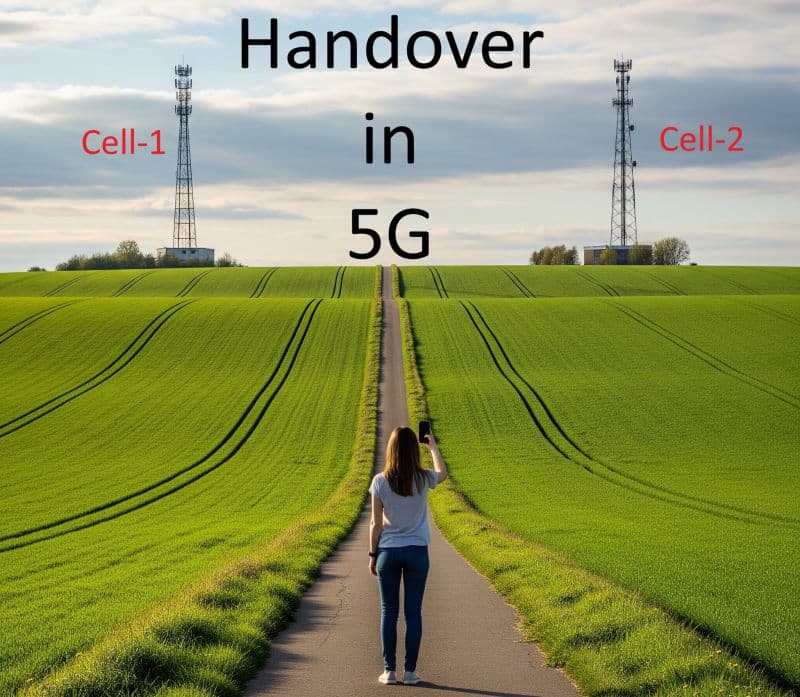
Imagine you are driving on a highway while talking on a video call. Your phone (UE) is connected to a nearby 5G cell tower (gNB). As long as you stay in that coverage area, the signal is strong, the call is smooth, and you don’t notice anything unusual.
But the moment you keep driving, you start moving out of that tower’s coverage zone. The signal strength begins to weaken. If nothing is done, your call would drop. That’s where handover comes in.
1. Initial Connection
- UE is connected to Serving Cell (let’s call it gNB-A).
- Everything is stable: video call quality is high, and latency is low.
2. Signal Weakens
- As the car moves farther from gNB-A, the Reference Signal Received Power (RSRP) and SINR drop.
- At the same time, the UE starts detecting neighbor cells (say gNB-B).
3. Measurement Reports
- The UE regularly measures neighbor cell signals as configured by gNB-A.
- Once gNB-B’s signal becomes stronger than gNB-A by a configured margin, the UE sends a Measurement Report to gNB-A.
4. Decision Point
- gNB-A decides that it’s time to switch the UE to gNB-B.
- It prepares gNB-B by sending the necessary context information (UE identity, security keys, buffer data).
5. Execution
- gNB-A tells the UE to hand over to gNB-B.
- The UE detaches from gNB-A and connects to gNB-B.
- The buffered data is forwarded from gNB-A to gNB-B to avoid data loss.
6. Completion
- UE confirms handover completion to gNB-B.
- The video call continues seamlessly without the user even realizing a handover took place.
Example in Numbers
- UE moving at 80 km/h.
- Serving cell RSRP drops from -80 dBm → -100 dBm.
- Neighbor cell RSRP rises from -95 dBm → -82 dBm.
- Handover triggered when neighbor cell exceeds serving cell by 3 dB (configured threshold).
Why Handover is Critical
- Without it, calls and sessions would drop as users move.
- It ensures mobility, reliability, and seamless connectivity in 5G networks.
- In high-speed scenarios (like trains), advanced algorithms like conditional handover are used for efficiency.
Takeaway: Handover is the invisible switch that makes mobile communication truly mobile. It keeps you connected while you move, whether you’re walking in a street or traveling at 300 km/h in a train.
LinkedIn: