I’ve been working on something I wanted to share.
While going through 5G NR NTN, I kept coming back to the same challenge: reading satellite position, velocity, timing and mobility parameters in a specification or configuration is one thing — actually visualizing what those values mean geometrically is another.
That became the starting point for what is now the QORELYN NTN Lab.
I initially wanted a simple way to take satellite state information and see the resulting orbit around Earth. From there, I kept adding the things I found useful while studying and analyzing NTN behavior.
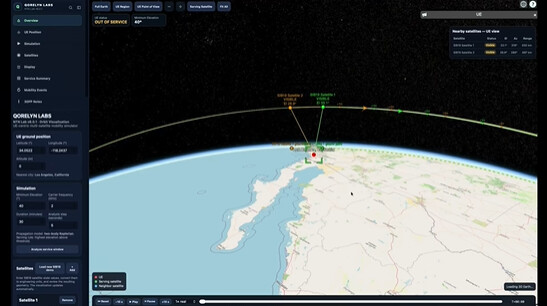
The current version has grown into a browser-based, UE-centric multi-satellite simulator.
Some of the features currently available:
 SIB19 Position/Velocity inputs
Enter raw PositionVelocity-r17 satellite-state values and convert them into engineering units.
 Interactive 3D visualization
View the complete Earth, zoom into the UE region, or look at the satellite geometry from the UE’s point of view.
 Multi-satellite simulation
Add multiple satellites and visualize serving and neighboring satellite behavior.
 Orbit & ground-track visualization
Display orbit paths, future trajectory, sub-satellite points, Earth-rotating ground tracks and direction of motion.
 UE–Satellite LOS links
Visualize straight line-of-sight geometry between the UE and satellites.
 Service-window analysis
Set a minimum elevation threshold and analyze when satellites become available to the UE.
 Mobility events
Observe how the preferred serving satellite can change as the geometry evolves.
 Time-based playback
Play the scenario forward and actually watch the satellite geometry change over time.
The goal of the tool is not to replace a network simulator or a 3GPP conformance platform.
It is meant to make NTN geometry and SIB19-oriented engineering concepts easier to explore, visualize and understand.
I’m attaching a short video showing the simulator running and the satellites moving around Earth.
I’ve also made the tool available online:
QORELYN NTN Lab v6.0.1 — Straight LOS Links
No desktop installation is required.
If you work with 5G NR, NTN, satellite communications, protocol testing or RAN, feel free to try it.
I’d genuinely appreciate feedback — especially on what would make the tool more useful for real engineering and validation workflows.
Technical basis: 3GPP NR NTN concepts including TS 38.331 SIB19/ephemeris information, with NTN timing and mobility concepts referenced across the 38-series specifications.
LinkedIn: 