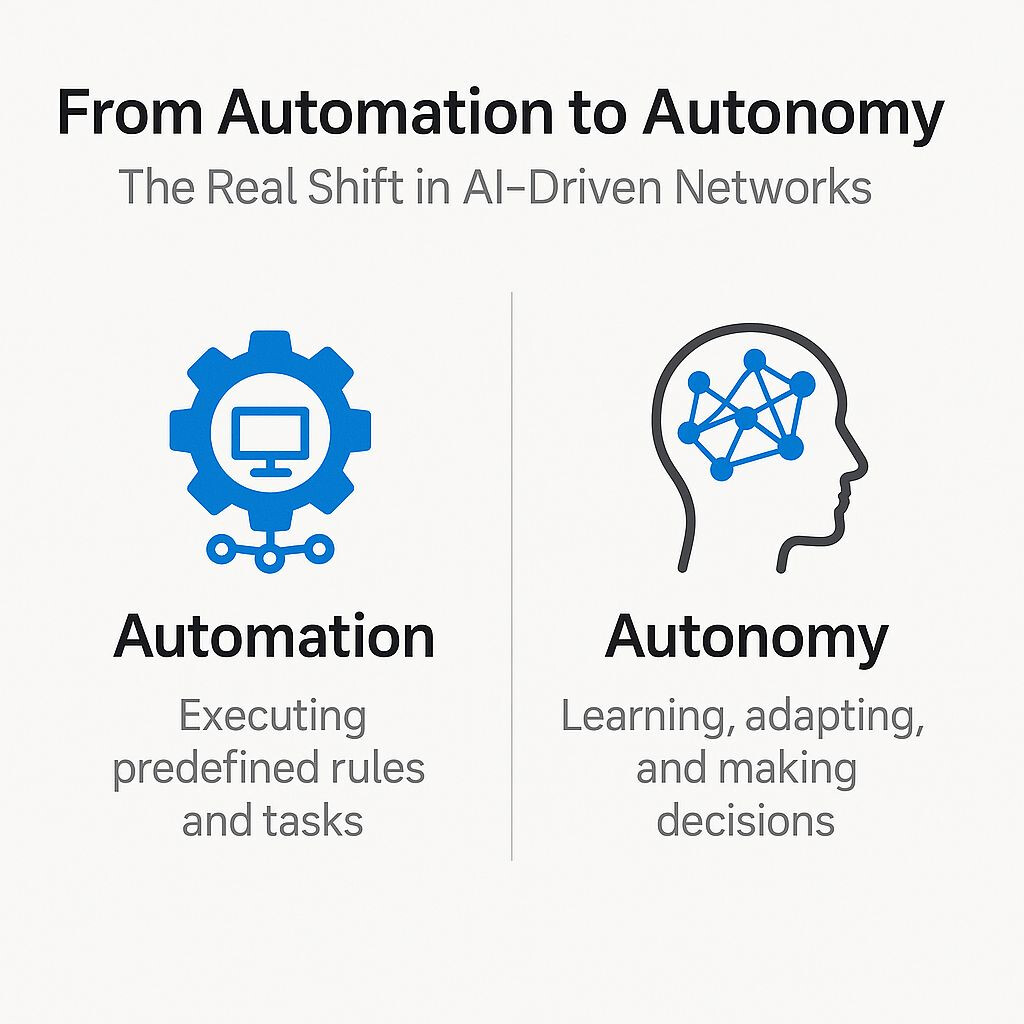
For years, automation has helped telecom operators streamline repetitive tasks and enforce consistency across large-scale operations. It enabled faster execution of predefined workflows, reduced manual effort, and minimized human error. But automation has always been limited by one thing: it can only perform what we explicitly tell it to do.
The emergence of AI-driven architectures is redefining that boundary. Autonomous networks introduce a fundamentally new paradigm — one where the system can learn, reason, and adapt in real time. Instead of merely executing rules, the network begins to understand context, predict behavior, and optimize itself based on dynamic conditions.
This shift is especially visible in the RAN, where complexity has outgrown what traditional automation can handle. Interference patterns, mobility dynamics, massive MIMO behavior, and traffic fluctuations demand continuous, data-driven decision-making that no static rule set can match.
AI-enabled platforms like rApps, xApps, and SMO frameworks are elevating the network from reactive to proactive — and ultimately to predictive — operation.
The future isn’t about performing the same tasks faster.
It’s about enabling networks to think.
This is the true frontier of autonomy, and it will define how 5G and 6G deliver value in the years ahead.
LinkedIn: 