 Based on 3GPP standards and real-world use cases, synchronization signals are the very first handshake between a mobile device and the network. These signals — PSS (Primary Synchronization Signal) and SSS (Secondary Synchronization Signal) — help a device locate and connect to the nearest cell tower, even in noisy or hostile radio environments.
⸻
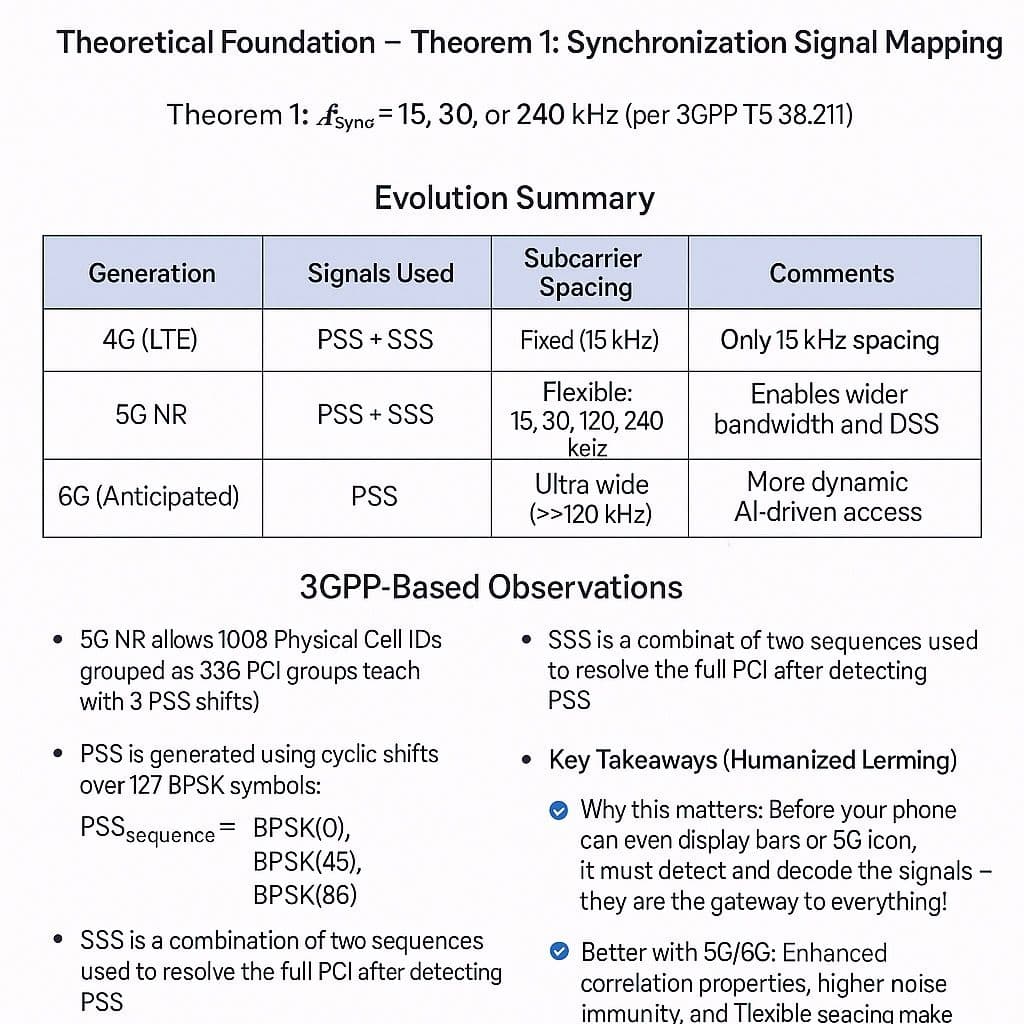
 Theoretical Foundation — Theorem 1: Synchronization Signal Mapping
For any gNB (5G NR base station), the synchronization subcarrier spacing must align with the operating band and hardware constraints:
 Evolution Summary:
Generation Signals Used Subcarrier Spacing Comments
4G (LTE) PSS + SSS Fixed (15 kHz) Only 15 kHz spacing
5G NR PSS + SSS Flexible: 15, 30, 120, 240 kHz Enables wider bandwidth and DSS
6G (Anticipated) PSS Ultra-wide (>>120 kHz) More dynamic, AI-driven access
⸻
 3GPP-Based Observations:
 5G NR allows 1008 Physical Cell IDs, grouped as 336 PCI groups (each with 3 PSS shifts).
 PSS is generated using cyclic shifts over 127 BPSK symbols:
{PSS}_{sequence} = BPSK (0), BPSK(43), BPSK(86)
 SSS is a combination of two sequences used to resolve the full PCI after detecting PSS.
⸻
Key Takeaways (Humanized Learning):
 Why this matters: Before your phone can even display bars or 5G icon, it must detect and decode these signals — they are the gateway to everything!
Better with 5G/6G: Enhanced correlation properties, higher noise immunity, and flexible spacing make these signals more robust.
Smart Deployment: 5G allows use of non-default subcarrier spacing (e.g., 30 kHz) for backward compatibility with LTE (e.g., DSS — Dynamic Spectrum Sharing).
⸻
 Sample Use Case — Code Reference:
Simplified PCI derivation from PSS + SSS
PCI = 3 * SSS_index + PSS_index # Total 1008 combinations
⸻
 From the field:
 15 kHz spacing works best for narrow-band channels (e.g., 5 MHz LTE reuse)
30 kHz spacing balances between legacy and new networks (good for DSS)
120/240 kHz fits massive MIMO and mmWave (Frequencies > 24 GHz)
⸻
Learnings Towards 6G:
In 6G, expect:
• Reduced latency in initial access
• AI-assisted signal prediction
• Wider support for dynamic spectrum allocation
⸻
 Let’s decode the radio universe, one signal at a time!
LinkedIn: 