What happens when the network initiates a Detach for an LTE device?
In Japan, we commonly observe this as a daily cycle (~24 hrs) across MNOs, triggering Detach with Reattach required.
Why does the network do this?
Several reasons are documented in 3GPP specifications and practical field experience:
 Security context reset
→ Forcing a fresh Attach resets the device’s security context (helps mitigate certain paging attacks).
[Ref: 3GPP TS 33.501 / Security notes]
GUTI Reallocation
→ GUTI (Globally Unique Temporary UE Identity) is periodically reallocated to avoid tracking risks and maintain correct UE identity state.
[Ref: 3GPP TS 23.401 §5.3.7]
PDN session refresh
→ Forces devices to renew IP address / PDN connection → this is commonly observed on Japanese networks to ensure session hygiene.
O&M housekeeping
→ Network may release UEs periodically to rebalance resources, enforce updated policies, or clear long-held sessions.
Congestion management
→ Detach may be triggered to manage network load (rare but possible).
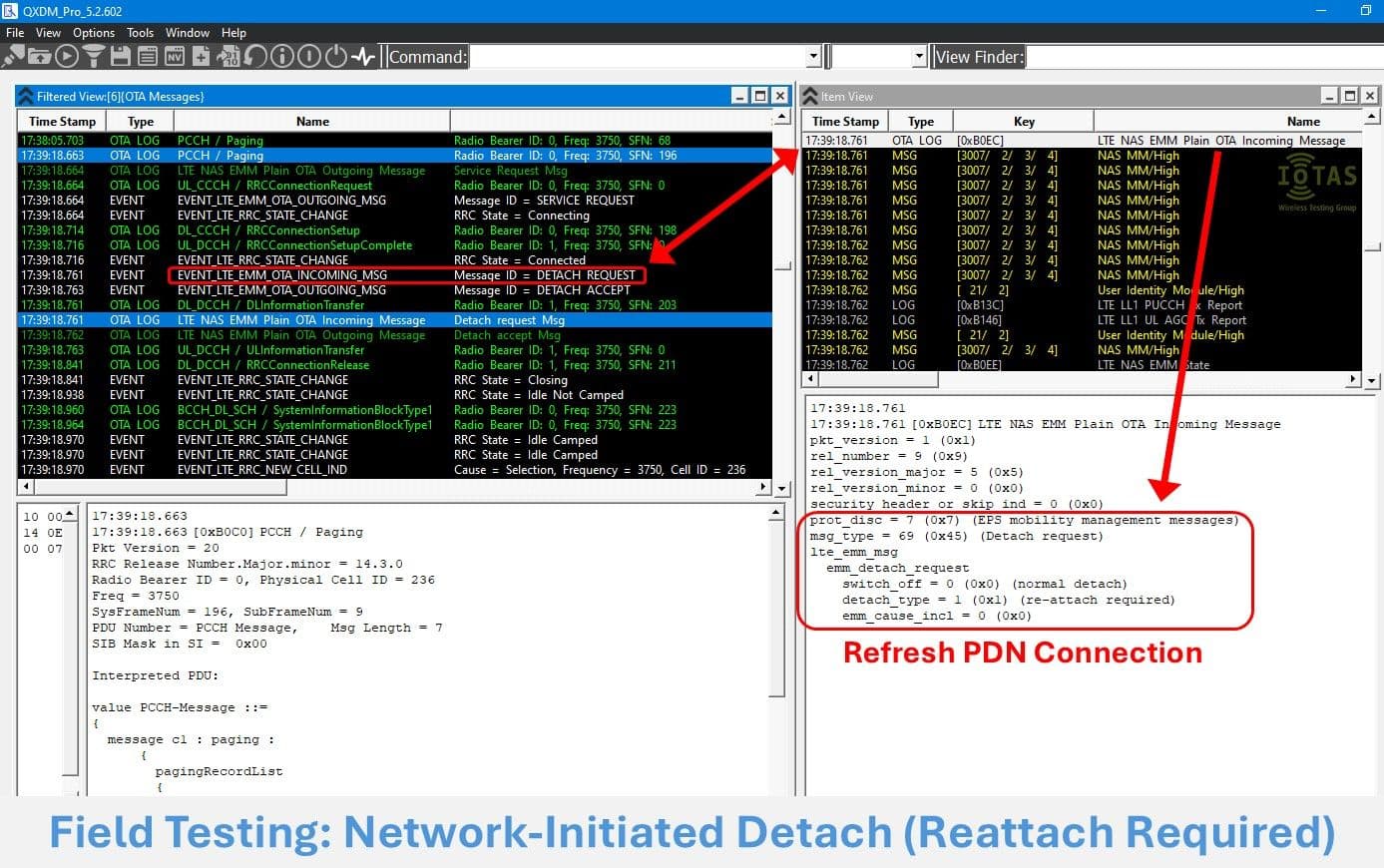
In this example:
 Network-initiated Detach Request received
detach_type = 1 (Reattach required)
Device responds → releases RRC → reattaches → fresh PDN session.
Why is this important for IoT?
It is not optional. Many networks perform this and devices must handle it correctly.
Poor implementations fail to reattach → go offline after ~24h → cause customer trouble.
Field testing this flow is critical, even though the behaviour is network-driven, device robustness matters.
A great example of where 3GPP specs, real network practice and field testing intersect. Not a “UE feature”, but something devices must support to interoperate reliably.
LinkedIn: 