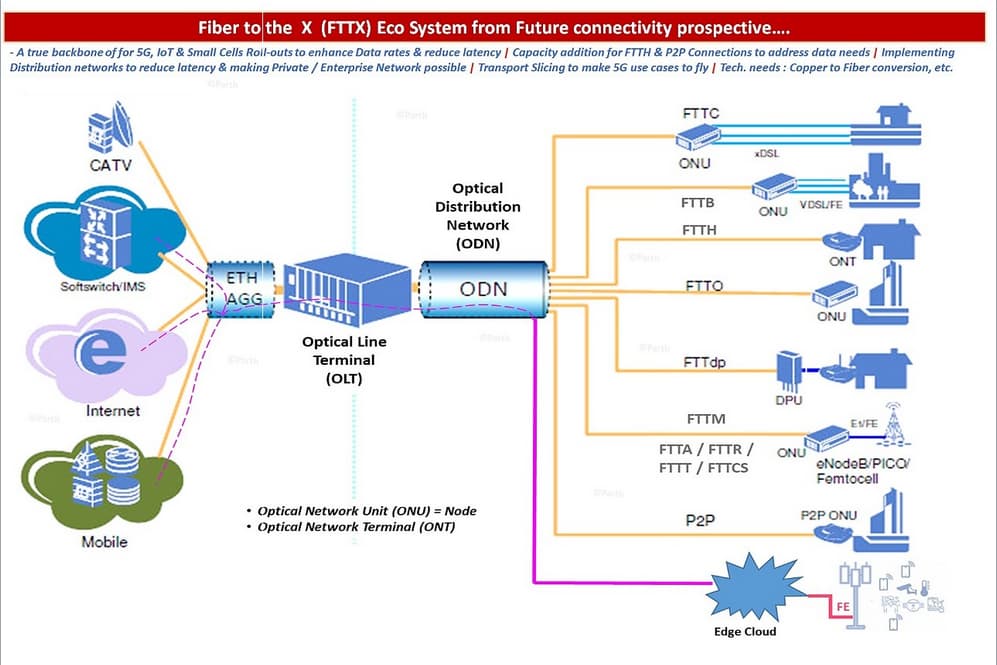
With such increase in demand, there is a need for 5G & FTTH / FTTX network convergence and hence we need to have a clear understanding of how Fiber to the X (FTTX) Eco System will acts as backbone considering Future connectivity prospective…
Below are key needs for FTTX Eco System rollouts :-
- A true backbone of for 5G, FWA, WiFi, IoT & Small Cells Roll-outs to enhance Data rates & reduce latency
- Capacity addition for FTTH & P2P Connections to address data needs. 3) Implementing Distribution networks to reduce latency & making Private / Enterprise Network possible.
- Transport Slicing to make 5G usecases to fly.
- Technology needs : Copper to Fiber conversion, etc.
- Possibility to make 5G SA rollout quickly and making more CU (Centralized Unit) / DU (Distributed Unit) / Edge units for full flag use of network slicing use cases / generic 5G use cases.
FTTx is a generic term encompassing various fiber optic access infrastructures, with the ‘X’ indicating the endpoint of the passive optical distribution network from the central telecom core location.
Common terminologies include FTTA, FTTH, FTTB, FTTC, FTTO, FTTdp, FTTR, FTTM, FTTP, and FTTD, etc. reflecting diverse applications in contemporary telecommunication networks.
Follow me for more updates
If you want to read and understand more → Fiber to the X (FTTX) Eco System from Future connectivity prospective
.
.
.
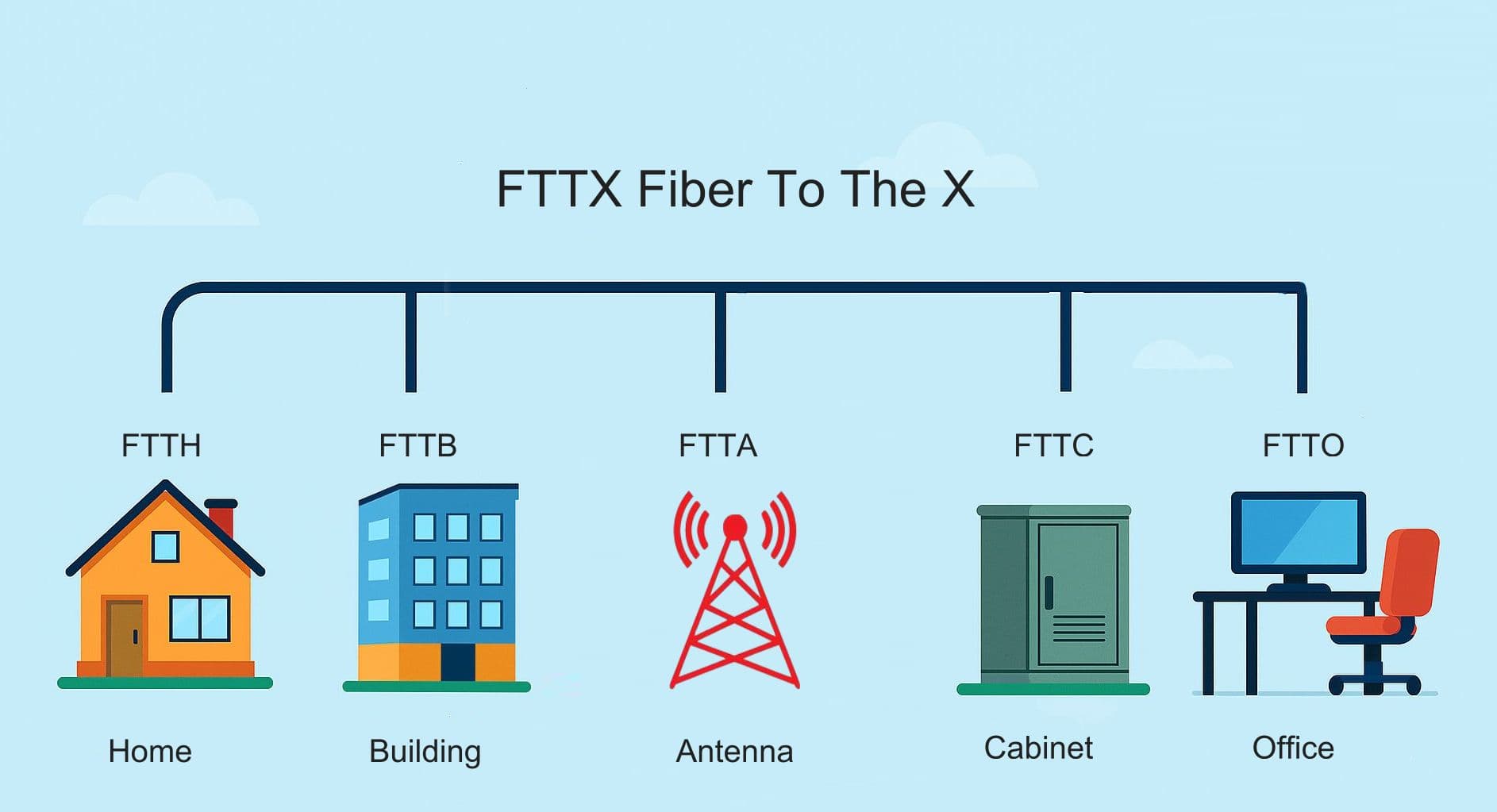
FTTx - Fiber To The X
Application and technical features of FTTx
-
FTTH (Fiber To The Home): Lay optical fiber directly to the user’s home to provide high-speed Internet access and TV services.
-
FTTB (Fiber To The Building): Lay optical fiber to the building and connect it to each household through a local area network.
-
FTTA (Fiber To The Antenna): Enables innovative, flexible and future-oriented network installation methods, especially suitable for scenarios requiring high data transmission speed and coverage.
-
FTTC (Fiber To The Cabinet): Extend optical fiber to the junction box on the street corner and connect it to the user’s home through copper wire or wireless technology.
-
* FTTO (Fiber To The Office): Designed for commercial office spaces, it provides high-speed and stable network connections.
Advantages of FTTx
-
Large-capacity transmission: The high bandwidth characteristics of optical fiber enable FTTx to support high-definition video, large data transmission and other needs.
-
High transmission quality: Optical fiber transmission reduces signal attenuation and interference, ensuring the stability and reliability of data transmission.
-
Long transmission distance: The transmission distance of optical fiber far exceeds that of copper wire, which is suitable for various complex network layout requirements.
-
Anti-electromagnetic interference: Optical fiber is not subject to electromagnetic interference and is suitable for stable transmission in high electromagnetic environments.