TDD Cross-Link Interference: When the Network Interferes With Itself
You see UL noise floor climbing. RACH failure rate is spiking. UL throughput is dropping for no apparent reason. The drive test shows nothing. The spectrum scan is clean. No jammer in sight.
And yet, the interference is real. It’s just not coming from where you think.
In TDD networks, one of the most underdiagnosed sources of interference is cross-link interference (CLI): the network literally interfering with itself because of synchronization loss or misaligned timeslot configurations between neighboring cells.
Let me explain how it happens, why it’s so hard to catch, and what 3GPP says about it.
How TDD slot alignment works
In TDD mode (used in 5G NR on bands like n78/n77/n41, and in LTE-TDD), all cells sharing the same frequency band divide time between downlink (DL) and uplink (UL). The slot pattern defines which slots are allocated to DL, which to UL, and which are special slots (S) containing the guard period.
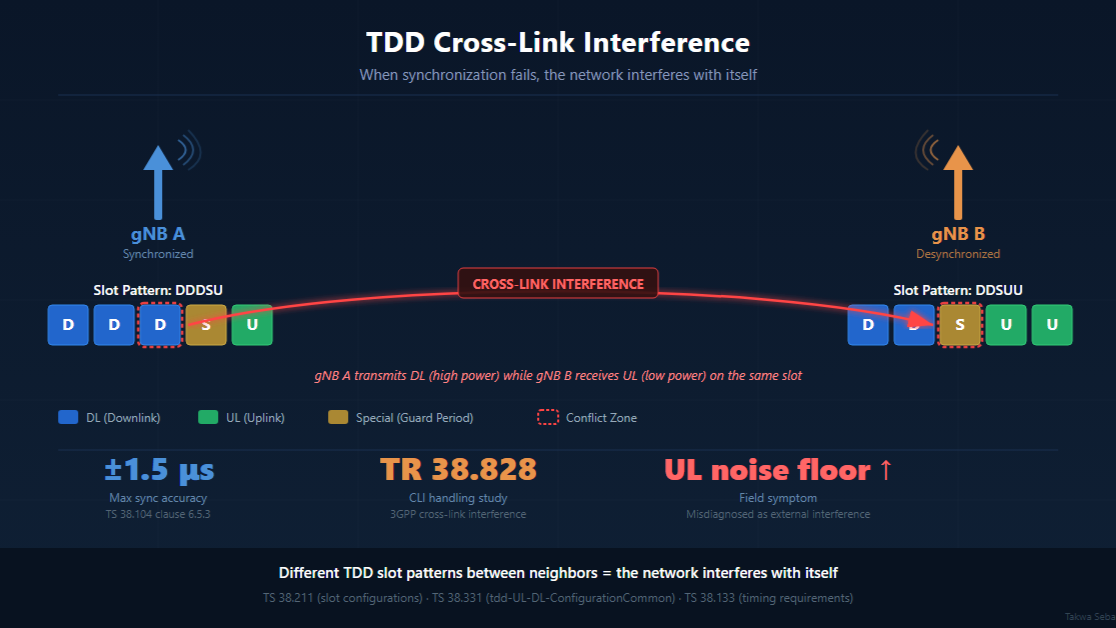
In 5G NR, this is configured through the RRC parameter tdd-UL-DL-ConfigurationCommon (TS 38.331). Typical patterns include DDDSU (3 DL slots, 1 special, 1 UL, DL-heavy for eMBB) and DDSUU (2 DL, 1 special, 2 UL, more balanced).
The special slot (S) contains a guard period (GP) that absorbs propagation delay between sites and allows RF switching from transmit to receive mode. For this system to work, one condition is absolutely critical: all neighboring cells on the same band must be synchronized and use compatible slot patterns.
What happens when synchronization fails
When two neighboring gNBs lose synchronization or operate with different DL/UL patterns, the timing of their slot boundaries diverges. One cell transmits downlink (high power, macro antenna) at the exact moment its neighbor is trying to receive uplink (low power, from the UE). This is cross-link interference.
The power differential is enormous: a macro DL signal (typically 40-46 dBm EIRP) overwhelming a UE uplink signal arriving at the gNB receiver at perhaps -90 to -100 dBm. 3GPP documents this in TR 38.828, which specifically studies cross-link interference handling in NR.
Three scenarios where CLI shows up in the field
-
Different operators on the same band with different TDD patterns. Common in shared spectrum or n78 deployments. If operator A runs DDDSU and operator B runs DDSUU, slot 3 is a guaranteed conflict zone.
-
GPS clock drift on a site. TDD synchronization relies on GPS-disciplined oscillators. When GPS signal is lost, the backup oscillator starts drifting. 3GPP requires +/-1.5 microseconds accuracy for wide-area BS (TS 38.104, clause 6.5.3). Beyond that, DL/UL boundaries overlap.
-
Small cells not synchronized to the macro layer. Indoor small cells or private network cells on the same TDD band without proper synchronization will generate CLI toward the macro UL.
Why this interference is so hard to diagnose
CLI does not look like traditional interference. You see an elevated noise floor on UL PRBs, but no identifiable interfering signal with a distinct PCI or frequency signature. The interference appears and disappears with the TDD frame timing, making it intermittent and hard to correlate.
Legacy RF scanning tools flag it as “external interference” because they cannot distinguish between a genuine external source and a neighboring cell’s DL transmission landing on the wrong slot. To confirm CLI, you need time-domain analysis aligned to the TDD frame structure, or CLI-RSSI measurements introduced in 3GPP Release 16.
The 3GPP framework
Key specifications: TS 38.211 clause 4.3.2 (56 slot formats), TS 38.331 (tdd-UL-DL-ConfigurationCommon), TS 38.104 clause 6.5.3 (sync requirements: +/-1.5 us wide-area, +/-3 us local-area), TS 38.133 (RRM timing), and TR 38.828 (CLI handling study with inter-cell coordination and CLI measurement procedures).
The bottom line
Next time your UL KPIs degrade with no identifiable source, before hunting for a jammer, check two things: Are all neighboring cells on the same TDD band using the same slot pattern? Is the GPS healthy on all sites in the cluster?
Different TDD slot patterns between neighbors means the network is interfering with itself. No amount of spectrum scanning will find that source, because the source is the network’s own DL transmission.
The interference is in the time domain, not the frequency domain. That changes everything about how you diagnose it.
Have you ever traced a UL degradation back to a TDD synchronization issue? Share your experience in the comments.
LinkedIn: 