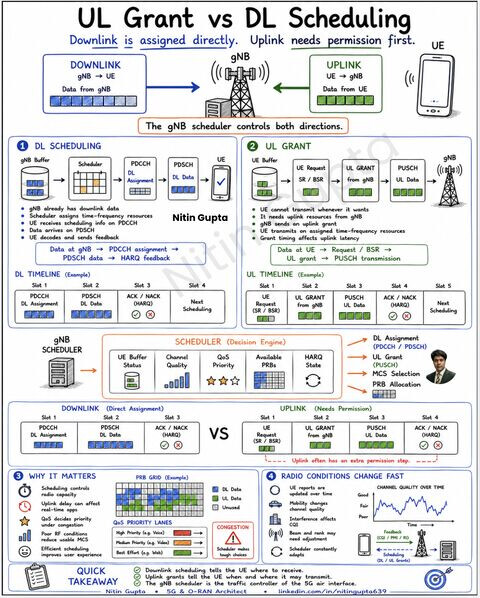
Downlink is assigned directly.
Uplink needs permission first.
This is one of the simplest ways to understand DL scheduling vs UL grant in 5G.
The gNB scheduler controls both directions.
But downlink and uplink behave differently.
1. Downlink scheduling
Downlink means:
gNB to UE
In downlink, the gNB already has data waiting in its buffer.
The scheduler decides which UE should receive data and which time-frequency resources to use.
The UE receives scheduling information on PDCCH.
Then the data arrives on PDSCH.
Basic flow:
- Data at gNB
- PDCCH assignment
- PDSCH data
- HARQ feedback
Simple memory:
Downlink scheduling tells the UE where to receive.
2. Uplink grant
Uplink means:
UE to gNB
The UE cannot transmit whenever it wants.
It first needs uplink resources from the gNB.
If the UE has data, it may send a request such as SR or BSR.
Then the gNB sends an uplink grant.
The UE transmits data on PUSCH using assigned resources.
Basic flow:
- Data at UE
- Request / BSR
- UL grant
- PUSCH transmission
- HARQ feedback
Simple memory:
Uplink grant tells the UE when and where it may transmit.
3. Why uplink has an extra step
In downlink, the gNB controls the data and the scheduler.
In uplink, the UE has the data.
But the gNB still controls the radio resources.
So the UE must first ask or report its buffer status.
That is why uplink often has an extra permission step.
4. What the scheduler considers
The gNB scheduler makes decisions based on:
- UE buffer status
- Channel quality
- QoS priority
- Available PRBs
- HARQ state
- MCS selection
- Congestion
- Fairness
The scheduler decides both DL assignments and UL grants.
5. Why it matters
Scheduling controls radio capacity.
Uplink delay can affect real-time apps.
QoS decides priority under congestion.
Poor RF conditions reduce usable MCS.
Efficient scheduling improves user experience.
6. Radio conditions change fast
The scheduler must keep adapting because:
- UE reports are updated over time
- Mobility changes channel quality
- Interference affects CQI
- Beam and rank may need adjustment
- Traffic demand changes quickly
This is why feedback and scheduling are continuous in 5G.
7. Quick takeaway
Downlink scheduling tells the UE where to receive.
Uplink grants tell the UE when and where it may transmit.
The gNB scheduler is the traffic controller of the 5G air interface.
LinkedIn: 