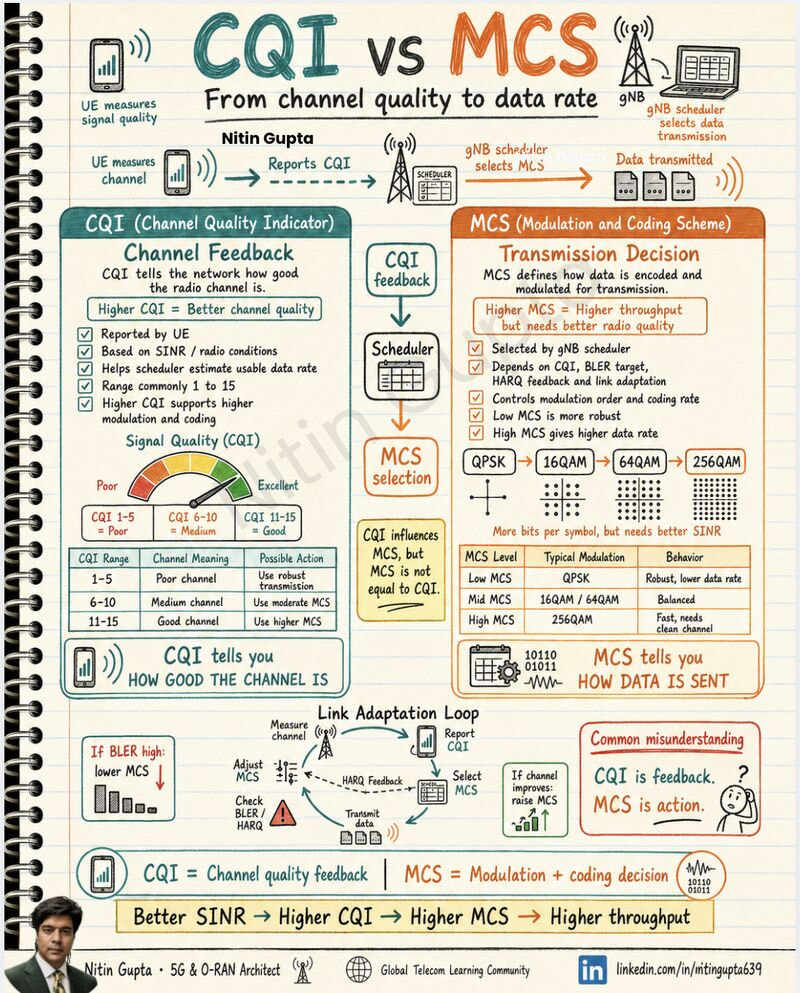
In LTE and 5G, CQI and MCS are closely connected, but they are not the same.
CQI means Channel Quality Indicator.
It is feedback from the UE to the network.
The UE measures radio conditions and reports how good the channel looks.
CQI helps the gNB scheduler understand what kind of transmission the channel may support.
Simple view:
Higher CQI = better channel quality
MCS means Modulation and Coding Scheme.
It is a transmission decision made by the gNB scheduler.
MCS decides how data will be encoded and modulated for transmission.
Simple view:
Higher MCS = higher throughput, but it needs better radio quality.
The relationship:
Better SINR → Higher CQI → Higher MCS → Higher Throughput
But remember:
CQI is feedback.
MCS is action.
CQI tells the network how good the channel is.
MCS tells the network how data should be sent.
If channel quality is poor, the scheduler uses lower MCS for more robust transmission.
If channel quality improves, the scheduler can use higher MCS for better data rate.
The link adaptation loop is:
Measure channel
Report CQI
Select MCS
Transmit data
Check BLER / HARQ
Adjust MCS
This is one of the most important concepts in LTE and 5G radio performance.
If you understand CQI, MCS, BLER and HARQ together, you understand how the network balances reliability and throughput.
Where did you first learn CQI and MCS: drive testing, RF optimization, protocol logs, RAN planning, or lab testing?
LinkedIn: 