A phased array is not defined simply by placing several antenna elements beside each other; its real force comes from controlling the relative phase and amplitude of every element. A common RF source is divided into multiple channels, and each channel is adjusted before feeding its antenna element. When the radiated waves combine constructively in one direction and destructively elsewhere, a focused main beam is created without mechanically rotating the antenna.
Behind the beam is a complete RF chain: power dividers, digital phase shifters, attenuators, drivers, power amplifiers, calibration couplers, isolators, and antenna elements. Phase controls the beam direction, while amplitude tapering controls side lobes and beam shape. However, phase quantization, gain imbalance, thermal drift, mutual coupling, and channel mismatch can reduce gain, shift the beam, and raise side lobes. Conventional phase-shifter steering can also produce beam squint across wide bandwidths because the same phase shift does not represent the same time delay at every frequency.
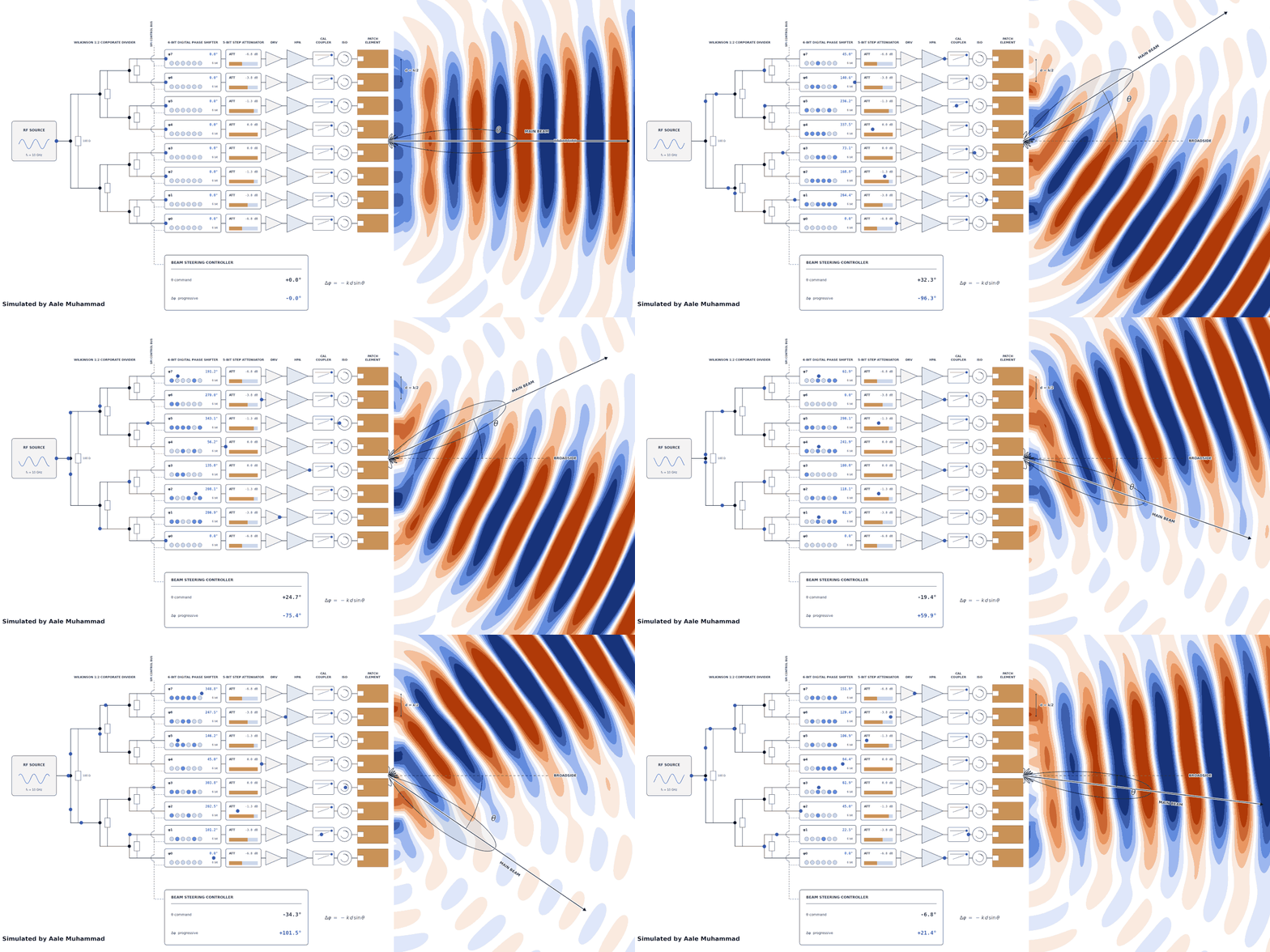
This simulation below shows an eight-element patch array operating at 10 GHz with half-wavelength element spacing. In the displayed broadside condition, all phase shifters are set to 0° while the symmetric attenuation profile reduces excitation toward the outer elements to control side lobes. As the steering command changes, a progressive phase difference is applied across the elements and the main beam turns electronically. The critical point is that the beam is not produced by one powerful antenna; it is created by accurate phase, amplitude, and calibration across the entire RF chain.
Critical Formulas:
a) Wavelength
→ λ = c / f
λ = wavelength, c = speed of light, f = operating frequency
b) Progressive phase shift
→ Δφ = −kd sinθ₀
Δφ = phase difference between adjacent elements, k = 2π/λ, d = element spacing, θ₀ = steering angle
c) Array factor
→ AF(θ) = Σₙ₌₀ᴺ⁻¹ wₙeʲⁿ⁽ᵏᵈˢⁱⁿθ⁺Δφ⁾
AF = combined array response, wₙ = complex element weight, N = number of elements
d) Digital phase resolution
→ Δφres = 360° / 2ᴮ
B = number of phase-shifter bits; a 6-bit phase shifter provides 5.625° phase steps
- In an AESA radar, hundreds or thousands of T/R channels change phase electronically so the beam can scan without rotating the antenna.
- In a 5G massive MIMO panel, phase and amplitude weights direct energy toward selected users while limiting interference toward others.
- In a flat-panel satellite terminal, electronic steering keeps the beam aligned with a moving satellite without using a conventional rotating dish.
- During chamber calibration, small phase or gain errors between channels can shift the main beam and raise side lobes even when every antenna element works individually.
LinkedIn: 