RF propagation is rarely as simple as “higher RSRP = better network.”
In real networks, the radio signal behaves very differently depending on the environment.
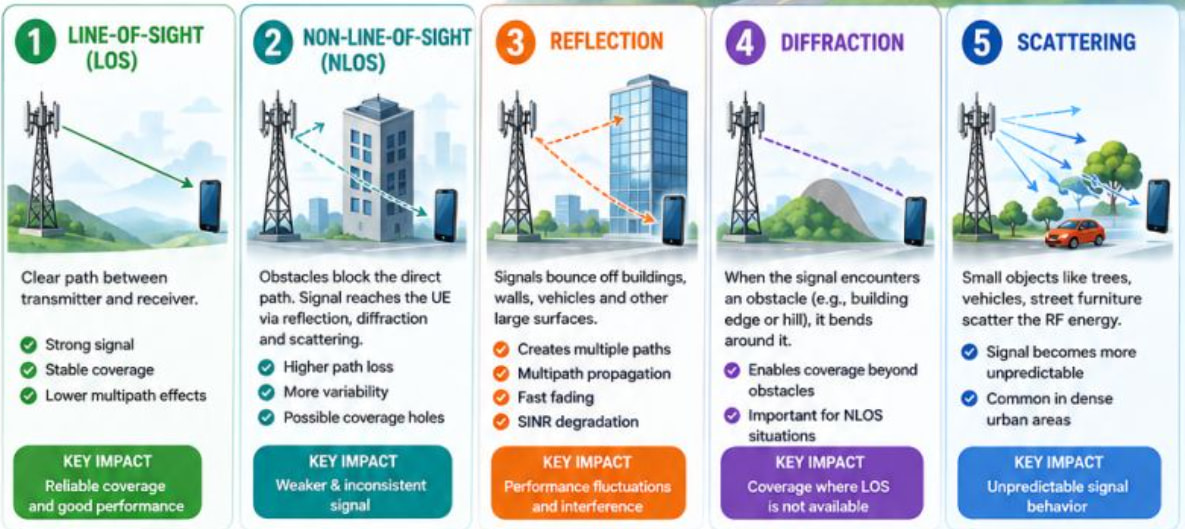
Here are some common situations RF engineers deal with every day
 1. Line-of-Sight (LOS)
The transmitter and receiver have a relatively clear path.
 Strong signal
Stable coverage
Lower multipath effects
Common in open areas and some rural deployments.
2. Non-Line-of-Sight (NLOS)
Buildings, terrain, trees, and other obstacles block the direct path.
The signal reaches the UE through reflection, diffraction, and scattering.
Higher path loss
More variability
Possible coverage holes
3. Reflection
RF signals bounce off buildings, walls, vehicles, and other large surfaces.
This can create multiple signal paths arriving at the UE at different times.
Multipath propagation
Fast fading
Potential SINR degradation
4. Diffraction
When the signal encounters an obstacle, such as a building edge or hill, part of the wave can bend around it.
This is one reason a UE can sometimes receive coverage even without direct visibility to the site.
5. Scattering
Small objects such as trees, street furniture, vehicles, and rough surfaces can scatter the RF energy.
Signal becomes more unpredictable
Particularly important in dense urban environments
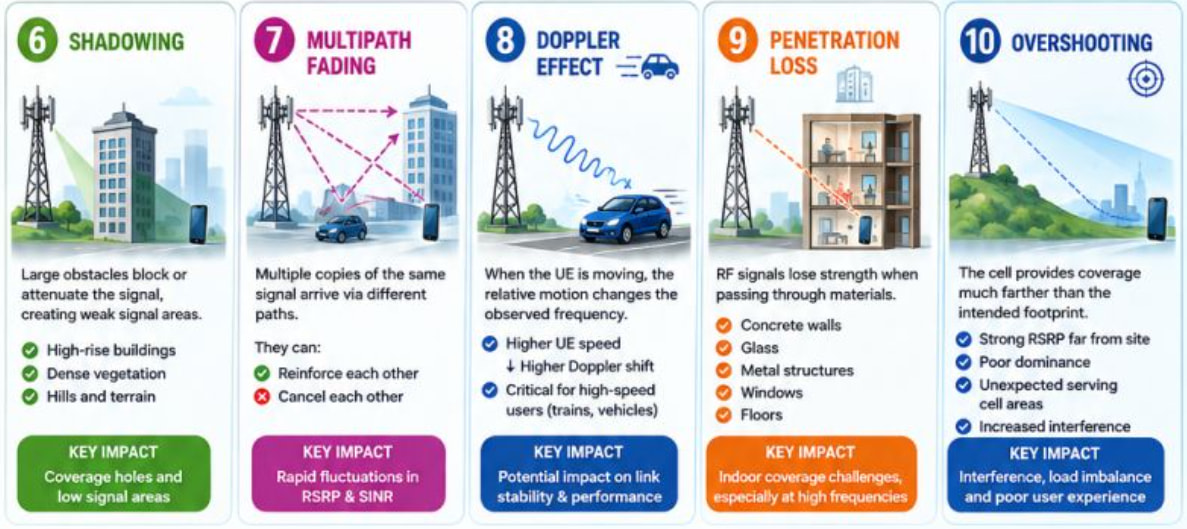
6. Shadowing
Large obstacles can create areas where the received signal is significantly weaker.
For example:
 High-rise building → weak signal behind it
 Dense vegetation → additional attenuation
 Hill → coverage shadow
7. Multipath Fading
Multiple copies of the same signal arrive at the UE through different paths.
Depending on their phase relationship, they can:
 Reinforce each other
 Cancel each other
This can cause significant fluctuations in RSRP and SINR over very short distances.
8. Doppler Effect 
When the UE is moving, the relative motion between transmitter and receiver changes the observed frequency.
Higher UE speed → higher Doppler shift.
This becomes especially important for high-speed users such as trains and vehicles.
9. Penetration Loss
Indoor users experience additional losses as RF signals pass through:
• Concrete walls
• Glass
• Metal structures
• Windows
• Floors
This is particularly important for higher-frequency 5G deployments.
10. Overshooting 
Sometimes a cell provides coverage much farther than its intended footprint.
You may see:
Strong RSRP far from the site
Poor dominance
Unexpected serving-cell areas
Increased interference
This is where antenna height, tilt, azimuth, propagation conditions, and terrain all become important.
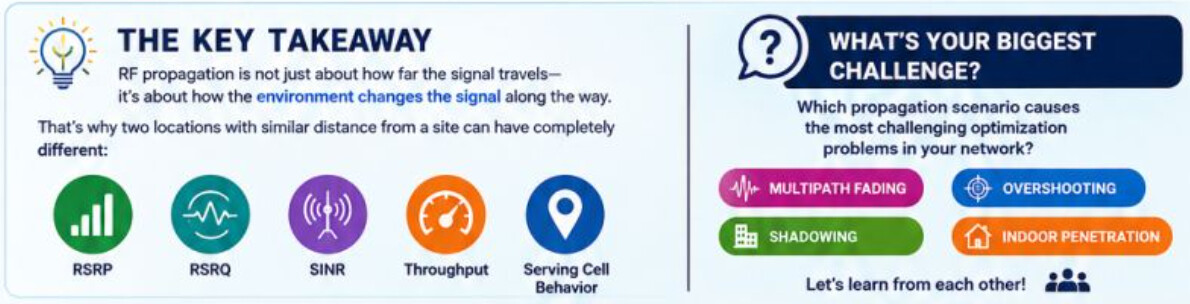
That’s why two locations with similar distance from a site can have completely different:
 RSRP
RSRP
 RSRQ
RSRQ
 SINR
SINR
 Throughput
 Serving-cell behavior
LinkedIn: 