Does anyone have a good document or presentation explaining Cloud RAN architecture?
Additionally:
Which vendors are currently offering Cloud RAN solutions?
Could you share any technical dump, reference material, or data related to the container-based implementation (e.g., container architecture, orchestration, deployment model)?
Please share any useful documentation or insights.
Primary Vendor Whitepapers (Architecture)
These documents explain the fundamental shift from “Classical” to “Cloud” RAN.
Ericsson: Cloud RAN - Virtually Everywhere – Focuses on disaggregating baseband software from hardware and the use of “Blueprints” with Intel.
Nokia: anyRAN: Cloud RAN Solution – Details their approach to supporting multiple cloud environments (private/public) using the same software.
Samsung: Samsung 5G vRAN – Provides deep dives into their fully virtualized RAN (vRAN) which has been deployed at scale by operators like Verizon.
Container & Infrastructure Standards
Cloud RAN relies on specific “Carrier Grade” Kubernetes distributions.
Red Hat: OpenShift for Telecommunications – The most common “CaaS” (Container as a Service) layer used in Cloud RAN. Look for their “Reference Design” for vDU/vCU.
Wind River: Wind River Studio – A specialized cloud platform optimized for the ultra-low latency requirements of the vDU.
O-RAN Alliance: O-RAN Cloud-Friendly Architecture (2024-2026) – The official body defining the interfaces (e1, f1, etc.) that allow different vendors’ containers to talk to each other.
Hardware Acceleration & Silicon
Since general CPUs aren’t fast enough for radio math, these sources explain the “Acceleration” layer.
Intel: FlexRAN Reference Architecture – Technical documentation on how Intel Xeon processors and ACC100/vRAN Boost cards process 5G signals in software.
NVIDIA: Aerial SDK for Cloud RAN – Documentation on using GPUs to accelerate “Layer 1” radio processing in a containerized environment.
Market Data & Forecasts (2026 Context)
Dell’Oro Group: RAN Market Predictions 2026 – Noted as a primary source for the data that Cloud RAN is expected to capture ~25% of the total RAN market by 2028.
ABI Research: 5G RAN Automation Platforms 2026 – Ranks vendors like Ericsson and Nokia on their ability to automate Cloud RAN deployments.
Data Summary for your “Container Dump”
If you are looking for specific configuration “data,” research these terms in the docs above:
Real-time Patch: PREEMPT_RT Linux Kernel.
Networking: SR-IOV and Multus CNI (essential for container networking).
Latency: The “Front-haul” latency must be under 100 microseconds for a vDU container to function correctly.
Does anyone have information about which vendors are being used by operators in Europe, particularly in France?
Also, which RAN technologies are currently adopted (C-RAN, O-RAN, or vRAN)?
To provide a solid foundation, a “Technical Data Dump” including a representative vDU Container YAML, the Protocol Stack Diagram, and a list of Authoritative Sources.
The vDU Container “Data Dump” (YAML Example)
In a Cloud-native RAN (5G), the vDU (Distributed Unit) pod requires specific “High-Performance Computing” settings in Kubernetes to handle radio signals.
apiVersion: v1
kind: Pod
metadata:
name: vdu-pod-5g
annotations: k8s.v1.cni.cncf.io/networks: sriov-fronthaul-network # Direct NIC access
spec:
runtimeClassName: performance-realtime # Uses Real-Time Linux Kernel
containers:
CPU Pinning: The limits and requests must be identical to trigger the “Guaranteed” QoS class in K8s, which prevents the CPU from switching tasks (jitter).
SR-IOV: This allows the container to bypass the virtual bridge and talk directly to the hardware at line speed.
HugePages: Standard 4KB memory pages are too small for radio buffers; 1GB pages reduce “Translation Lookaside Buffer” (TLB) misses.
The O-RAN Architecture & Protocol Stack
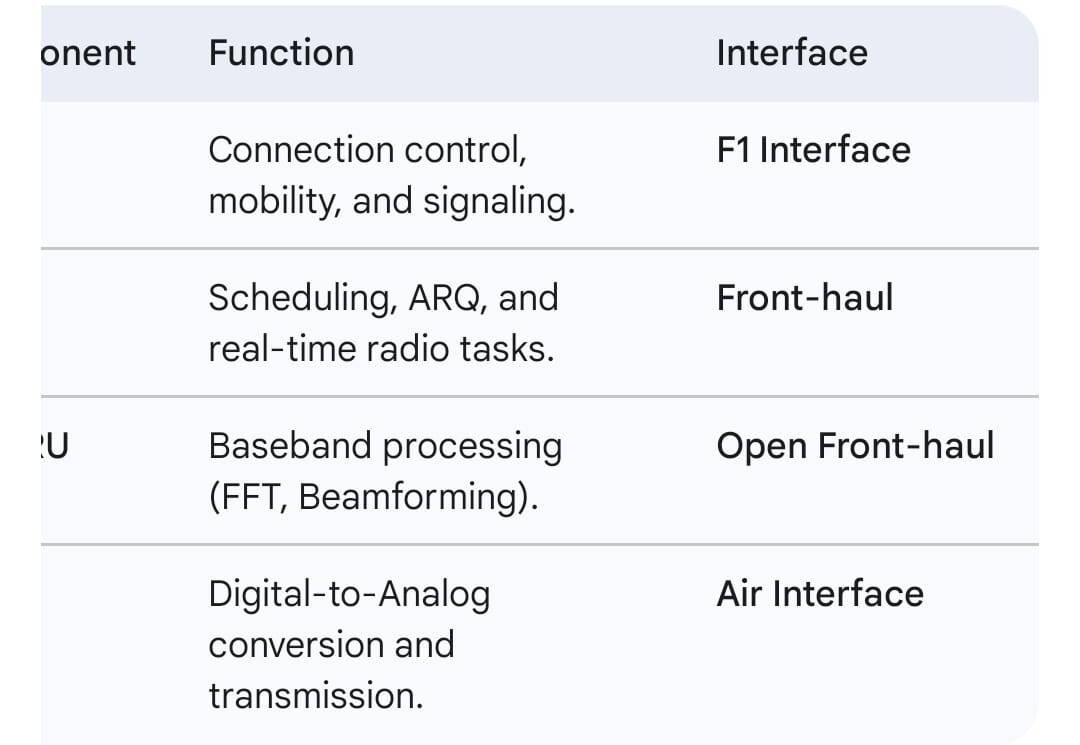
For your presentation, you can reference this logical flow of data through the “Split 7.2x” (the industry standard for Cloud RAN).
| Layer | Component | Function | Interface |
|—|—|—|—|
| L3 / RRC | vCU | Connection control, mobility, and signaling. | F1 Interface |
| L2 / MAC | vDU | Scheduling, ARQ, and real-time radio tasks. | Front-haul |
| L1 / PHY | vDU/RU | Baseband processing (FFT, Beamforming). | Open Front-haul |
| RF | RU | Digital-to-Analog conversion and transmission. | Air Interface |
Verified Sources (For Citations)
To ensure your document is credible, use these primary sources:
Standardization Body: * O-RAN Alliance Specifications: O-RAN Specifications
. Look for “WG4” (Front-haul) and “WG6” (Cloudification).
Infrastructure Design (Red Hat):
OpenShift for Edge Computing (2025/2026): docs.redhat.com.
This details the “Zero Touch Provisioning” (ZTP) for vDU containers.
Hardware Reference (Intel):
Intel FlexRAN Reference Architecture: intel.com/flexran.
This is the industry-standard software for L1 processing on Xeon processors.
In France, the RAN landscape is currently undergoing a massive transformation. As of early 2026, the market is shifting from four players toward a potential three-player market (due to the ongoing acquisition of SFR by the other three operators), which is directly impacting vendor choices.
the technology and vendors for the major French operators:
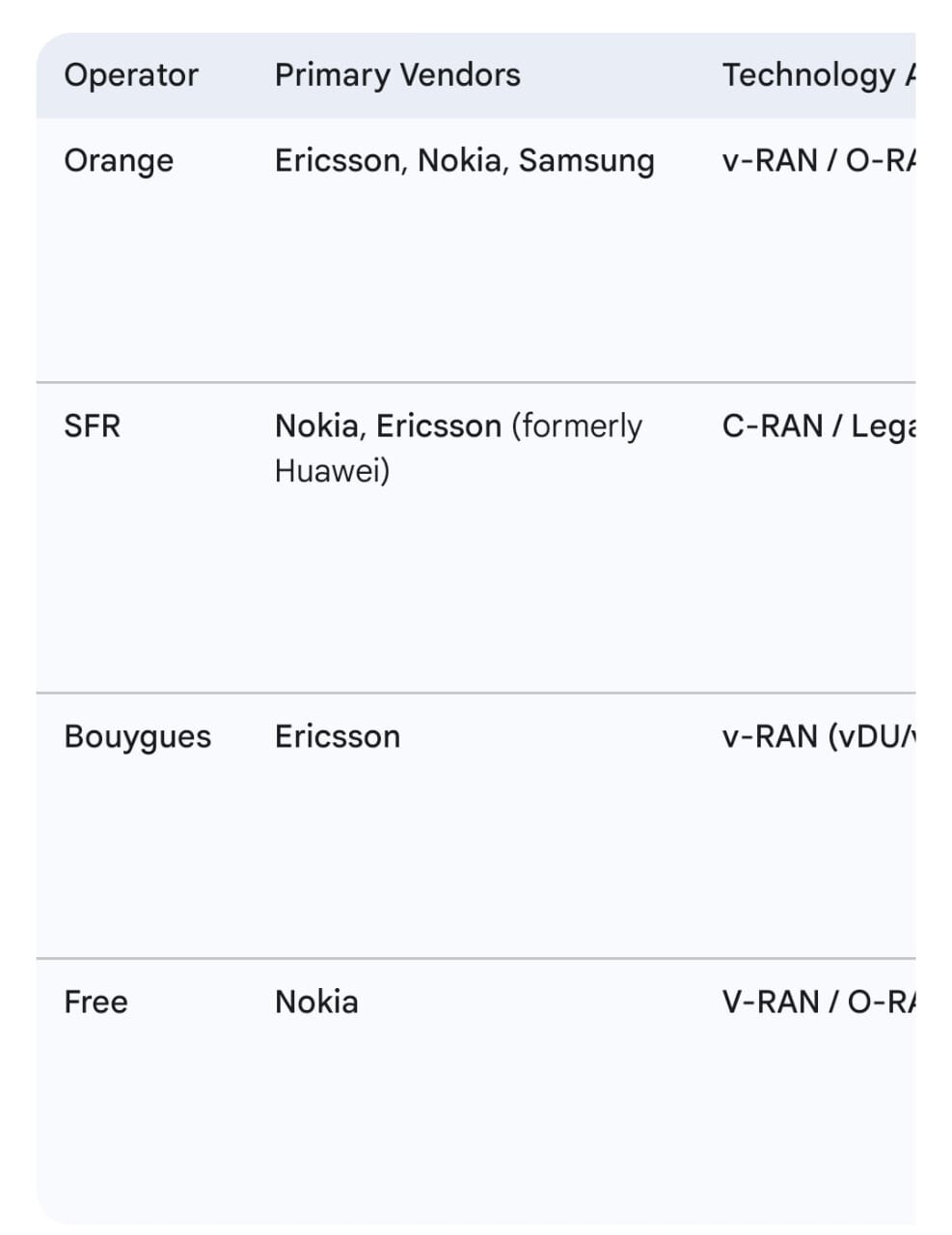
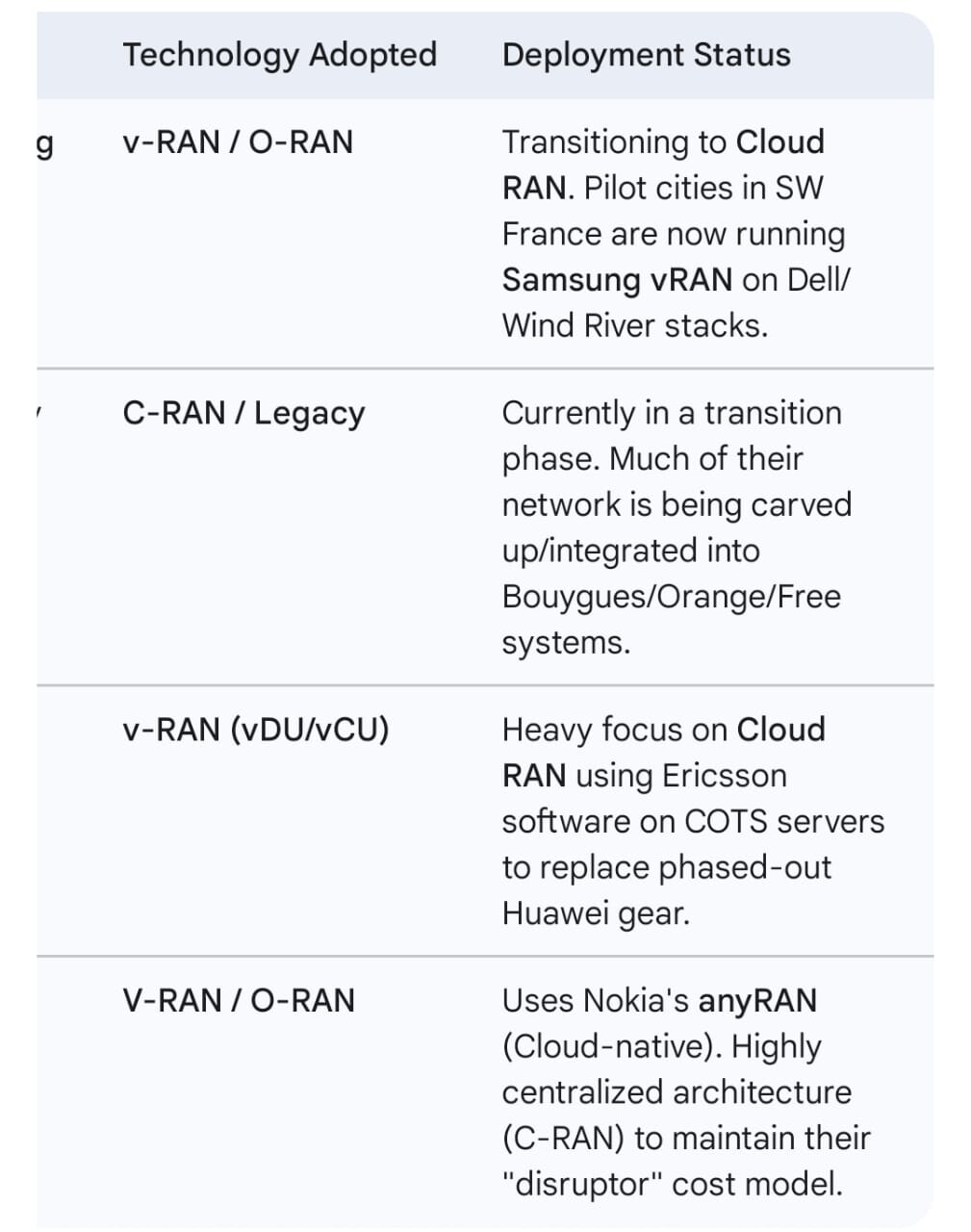
Vendor & Technology Mapping (France 2026)
| Operator | Primary Vendors | Technology Adopted | Deployment Status |
|—|—|—|—|
| Orange | Ericsson, Nokia, Samsung | v-RAN / O-RAN | Transitioning to Cloud RAN. Pilot cities in SW France are now running Samsung vRAN on Dell/Wind River stacks. |
| SFR | Nokia, Ericsson (formerly Huawei) | C-RAN / Legacy | Currently in a transition phase. Much of their network is being carved up/integrated into Bouygues/Orange/Free systems. |
| Bouygues | Ericsson | v-RAN (vDU/vCU) | Heavy focus on Cloud RAN using Ericsson software on COTS servers to replace phased-out Huawei gear. |
| Free | Nokia | V-RAN / O-RAN | Uses Nokia’s anyRAN (Cloud-native). Highly centralized architecture (C-RAN) to maintain their “disruptor” cost model. |
Technology Adoption Explained
The French market uses a mix of these three overlapping terms:
C-RAN (Centralized RAN): This is the standard in France. Operators like Free Mobile have centralized their basebands in “hotels” for years to save on electricity and rent.
V-RAN (Virtualized RAN): This is the current trend. Orange and Bouygues are moving away from proprietary hardware “boxes” to running RAN software on servers (like Dell or HP).
O-RAN (Open RAN): Orange is the biggest advocate here. They are moving toward “Open Front-haul” (the 7.2x split), which allows them to use a Samsung software brain with a different vendor’s radio antenna.
Key Market Insights (2026 Context)
The “Huawei Swap”: French law (the “Anti-Huawei Law”) has forced operators—specifically SFR and Bouygues—to strip out Huawei equipment. This has accelerated the move to Cloud RAN, as it’s faster to deploy software-based Ericsson/Nokia solutions than to install traditional hardware.
**Orange’s “Samsung” Shift: Historically a Nokia/Ericsson shop, Orange France has recently integrated Samsung for its vRAN/Open RAN pilots. This is a major shift to increase competition among their vendors.
The SFR Acquisition: As Orange, Bouygues, and Free look to absorb SFR’s assets, there is a massive project to “virtualize” SFR’s legacy physical sites to make them compatible with the modern cloud-native cores of the buyers.
Below is a more advanced Kubernetes manifest, reflecting the specific configurations used by vendors like Samsung or Nokia on platforms like Red Hat OpenShift or Wind River Studio.
YAML
apiVersion: v1
kind: Pod
metadata:
name: vdu-worker-node
annotations:
# High-speed networking using SR-IOV for Fronthaul k8s.v1.cni.cncf.io/networks: ‘[ { “name”: “sriov-fh-data”, “interface”: “eth0” } ]’
spec:
runtimeClassName: performance-telco-realtime # Points to a kernel with PREEMPT_RT
containers:
I don’t believe operators still use Huawei in the RAN or Core Network. However, Huawei equipment may still be present in other domains such as storage, cloud infrastructure, and IP networking.