Can we decrypt WPA2/WPA3 encrypted Wi-Fi frames in Wireshark without capturing the 4-Way Handshake? Yes, it’s possible by using the TK (Temporal Key), which is derived from the PTK (Pairwise Transient Key).
Typically, WPA/WPA2 frame decryption in Wireshark requires the SSID, password, and a captured 4-Way Handshake. For WPA3, decryption usually requires the PMK (Pairwise Master Key), which can be obtained from hostapd or wpa_supplicant logs using the -K flag and 4-Way Handshake. However, if you already have access to the PTK/TK from hostapd or wpa_supplicant logs, the 4-Way Handshake capture is no longer required. The reason is that the 4-Way Handshake is only used to derive the PTK/TK. Once the final encryption key (TK) is available, Wireshark can directly decrypt the unicast encrypted frames.
Example:
PTK: b4c7ff35140c60aa19f49ee7fa33512ed0b590fc61d7487caef6e2df9e7597d0936f7f241ad9f4f0b46861167925dcc5
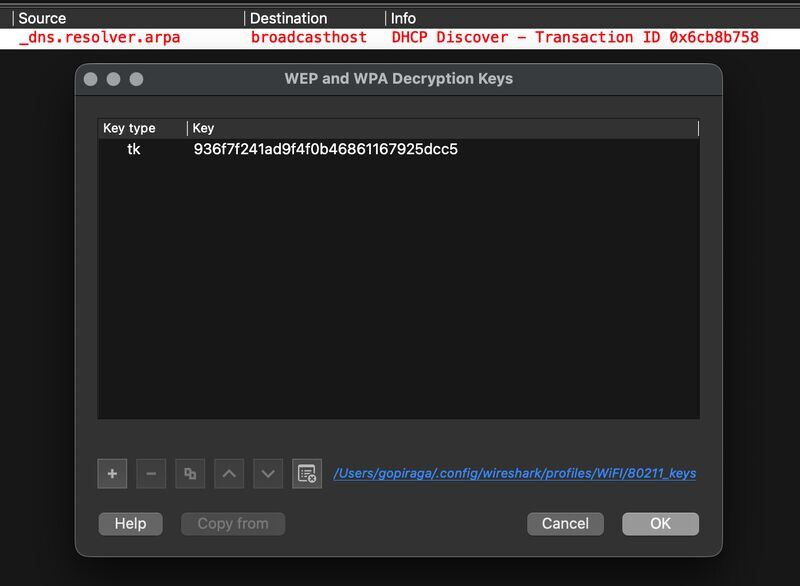
TK: 936f7f241ad9f4f0b46861167925dcc5
In Wireshark: Preferences → Protocols → IEEE 802.11 → Decryption Keys → Edit → Select: Key Type = TK → add the TK value.
Once added, Wireshark can decrypt all unicast encrypted frames, even if the 4-Way Handshake was not captured.
This is useful in scenarios where the 4-Way Handshake was missed during packet capture, or only partial packet captures are available. It’s a small but useful for Wi-Fi debugging and packet analysis.

LinkedIn: 