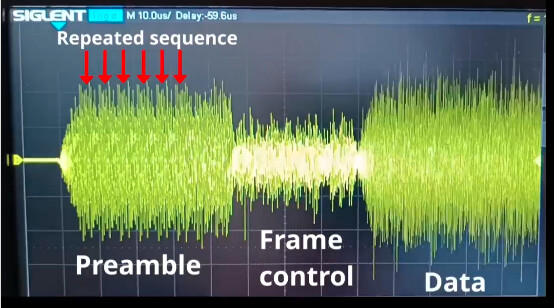
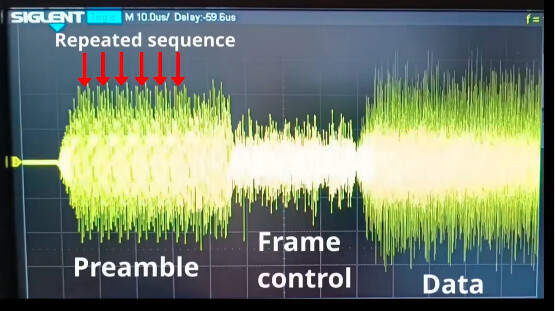
Decoding and demodulation can’t begin without synchronization. This is a real-time capture of that critical first step - the OFDM preamble as it unfolds in the signal.
In OFDM systems, the preamble plays a vital role in allowing the receiver to detect frame boundaries, align in time, and estimate frequency offsets. Without accurate synchronization, even the most advanced modulation and coding schemes are ineffective - the receiver simply wouldn’t know when or how to interpret the incoming data.
Many preambles, such as those used in IEEE 802.11 (Wi-Fi), rely on sequence repetition. For instance, the Short Training Field (STF) consists of repeated sequences specifically designed for robust detection. These patterns produce strong autocorrelation peaks, which synchronization algorithms can leverage.
One of the most widely used techniques is the Schmidl & Cox algorithm, which utilizes these repetitions to estimate the start of the OFDM symbol (timing synchronization) and correct for carrier frequency offset. It remains a foundational approach due to its efficiency and reliability. Beyond Schmidl & Cox, other methods - such as cross-correlation techniques including matched filtering and even machine learning-based detectors - are actively researched and implemented, depending on trade-offs in complexity, latency, and noise performance.
This post includes a short video captured using a SIGLENT oscilloscope connected to a live communication system. The trigger is adjusted to visually stabilize the preamble, clearly highlighting the repeated structure within the preamble - even as the payload data varies from burst to burst. This repetition is precisely what synchronization algorithms rely on for accurate detection.
Based on what you see in the preamble and spectrum - can you guess which communication standard this is?
If you’re interested in exploring OFDM synchronization further, here are two great resources:
-
Robust Frequency and Timing Synchronization for OFDM
-
Synchronization Techniques for Orthogonal Frequency Division Multiple Access (OFDMA): A Tutorial Review
LinkedIn: 