Why do towers look unchanged yet act smarter?
Because the change isn’t in metal - it’s in architecture.
At first glance, every base station seems identical.
Antennas, radios, and fiber cables - it’s all familiar.
But beneath that, the brains of the network have quietly moved to the cloud.
Here’s how it evolved:
-
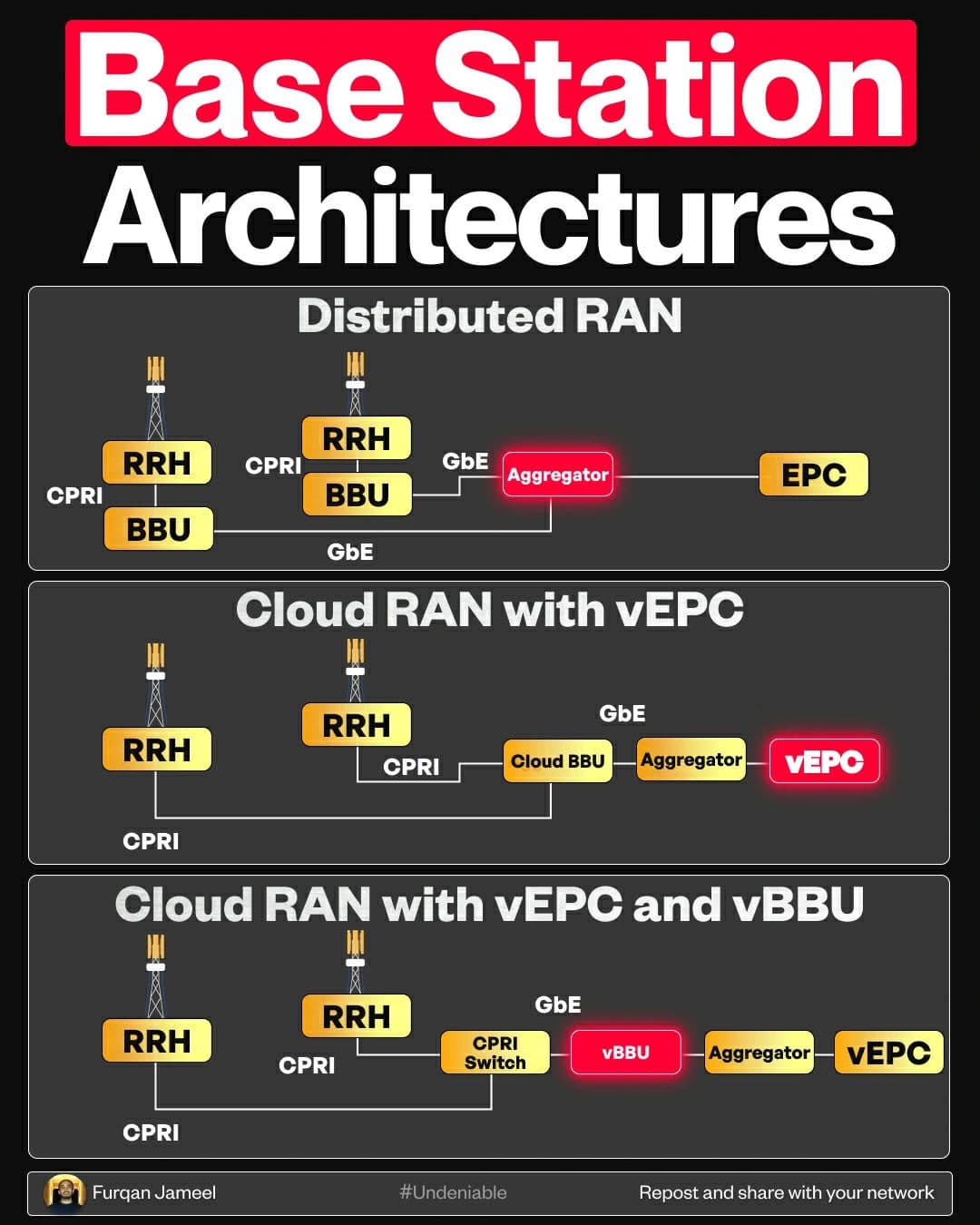
Distributed RAN (D-RAN)
Each site runs independently.
The BBU (Baseband Unit) and RRH (Remote Radio Head) sit close, connected by CPRI.
Simple, but hard to scale and costly to maintain. -
Cloud RAN with vEPC
The BBU moves to the cloud, forming a Cloud BBU.
Traffic flows to a virtual EPC (vEPC)—making control and management more centralized.
This setup boosts flexibility and reduces on-site hardware. -
Cloud RAN with vEPC and vBBU
Now both the EPC and BBU go virtual.
A CPRI switch links RRHs to a vBBU hosted in the cloud.
This makes upgrades faster, resources shared, and latency lower.
I remember the first time I saw this model in action - it felt less like telecom and more like distributed computing.
The line between networks and data centers was gone.
So yes, the towers still stand tall.
But the real power of networks lives somewhere invisible - inside the cloud, where flexibility beats hardware every time.
Thanks for reading.
LinkedIn: 