It is often requested to get an analytical formula for the throughput (i.e. TBS (Transport Block Size)) vs. SINR, MIMO rank, and modulation order, either as drive test results or as an analytical formula. Jio Platforms Limited (JPL) implements a lot of planning and optimization projects to forsee and define some good practices on 5G products.
Following 3GPP RAN standards on Link Adaptation and rank selection, the higher the SINR the more generally allows for higher modulation orders and better coding schemes, resulting in higher data rates. Moreover the higher the MIMO the rank, it allows for multiple spatial streams increasing the overall data throughput. The Modulation Order defines and determines the number of bits per symbol (e.g., QPSK = 2 bits/symbol, 16-QAM = 4 bits/symbol, 64-QAM = 6 bits/symbol, 256-QAM = 8 bits/symbol).
Apart from Drive Test measurements a common way to model the TBS vs. SINR, MIMO rank, and modulation order is to use the Shannon-Hartley theorem, which relates capacity to bandwidth and SINR. However, in practice, we can use modulation and coding schemes (MCS) that approximate this theoretical capacity.
The general form for TBS can be written as:
TBS = Nsymbols × Modulation_Order × MIMO_Rank × Efficiency x MCS_order_scaling.
Where:
Nsymbols is the number of symbols per transmission time interval (TTI), which depends on the bandwidth and subcarrier spacing.
Modulation_Order is the number of bits per symbol.
MIMO_Rank is the number of spatial streams.
Efficiency accounts for coding and other losses (often a value between 0 and 1).
MCS_order_scaling defines a linear ceiling function for diferrent I_MCS vs. SINR
As for a detailed Formula we can assume:
Nsymbols is constant for simplicity, Modulation_Order is selected based on SINR and Efficiency is a function of SINR, improving with higher SINR.
Regarding Modulation Order as a Function of SINR, let’s define some common practice in 3GPP Link Adaptation (of course a detailed mapping is left to the vendor implementations) the modulation order based on SINR ranges:
- QPSK (2 bits/symbol): SINR<10 dB
- 16-QAM (4 bits/symbol):10 dB≤SINR<20 dB
- 64-QAM (6 bits/symbol): 20 dB≤SINR<30 dB
- 256-QAM (8 bits/symbol): SINR≥30 dB
Finally the Efficiency can be approximated as a logistic function:
E=1 / (1+e^(−(SINR−15)/5))
Finalizing a complete Formula could be approximated as:
TBS = Nsymbols × M(SINR) × MIMO_Rank × E(SINR) x MCS_order_scaling
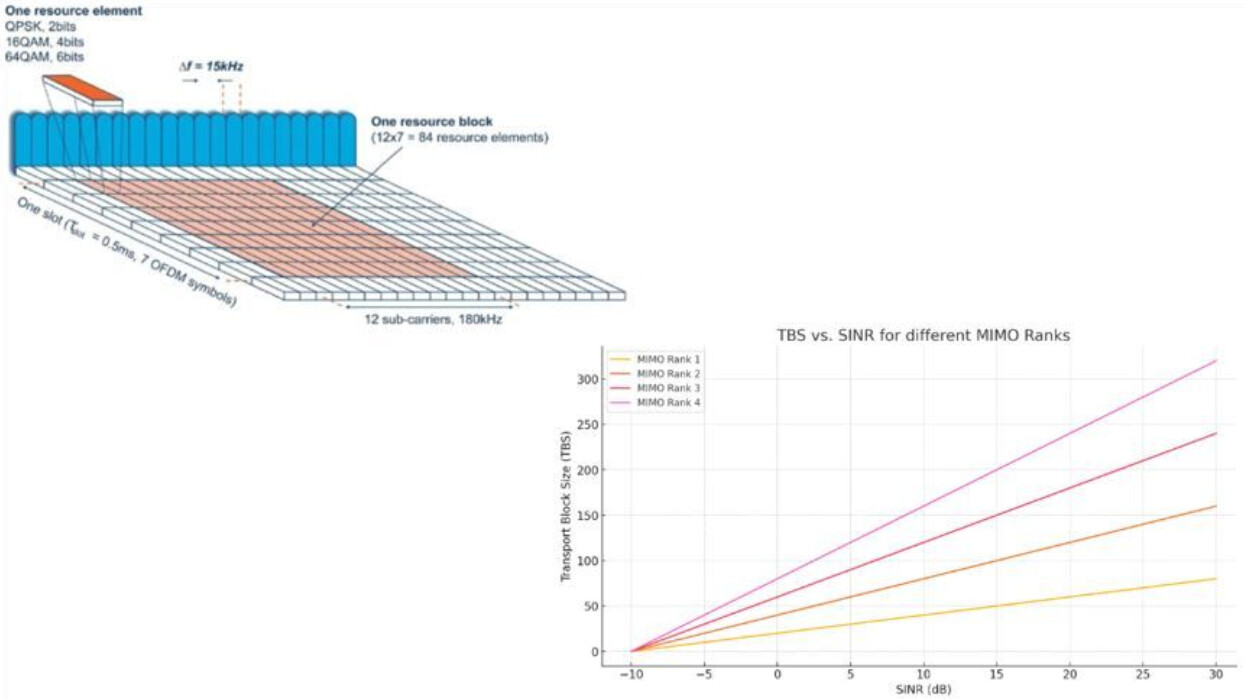
A graph produced out of a simulator for QPSK cell edge user (one Resource Block RB) follows:
LinkedIn: 