A NOC engineer typed this into an AI:
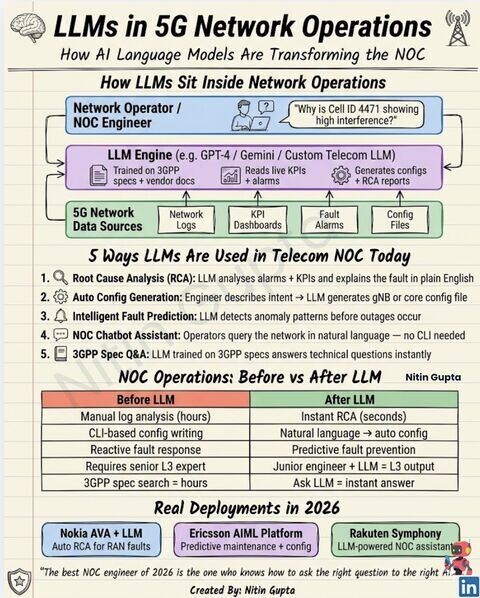
“Why is Cell ID 4471 showing high interference?”
In 4 seconds, the LLM returned a complete root cause analysis — referencing live KPIs, recent alarms, and 3GPP spec parameters.
No CLI. No manual log digging. No waiting for the L3 expert.
This is not a demo. This is happening in real networks right now.
Here is what most telecom engineers do not yet realise about LLMs in 5G operations:
The LLM is not replacing the engineer. It is sitting between the engineer and the network — trained on 3GPP specs, reading live KPI dashboards, fault alarms, and config files simultaneously — and translating all of it into plain English answers.
The results are difficult to ignore.
Tasks that used to take hours now take seconds. Junior engineers are producing L3-quality output. Network configs that required senior architects are now generated from a single sentence of intent.
Nokia AVA is doing it for RAN fault analysis.
Ericsson’s AI/ML platform is doing it for predictive maintenance.
Rakuten Symphony has an LLM-powered NOC assistant already in production.
The operators moving fastest on this are not the largest ones. They are the ones willing to rethink how a NOC works from the ground up.
The best NOC engineer of 2026 is not the one who knows the most commands.
It is the one who knows how to ask the right question to the right AI.
Are you already using LLMs in your network operations — or is your team still on manual log analysis?
Drop your honest answer below. 
LinkedIn: