Everyone’s talking about 6G speeds. Terahertz bands. AI-native cores. Sub-millisecond latency.
Almost no one’s talking about the thing that actually changes first:
Your job.
Here’s what’s coming for telecom engineers- quietly, but fast.
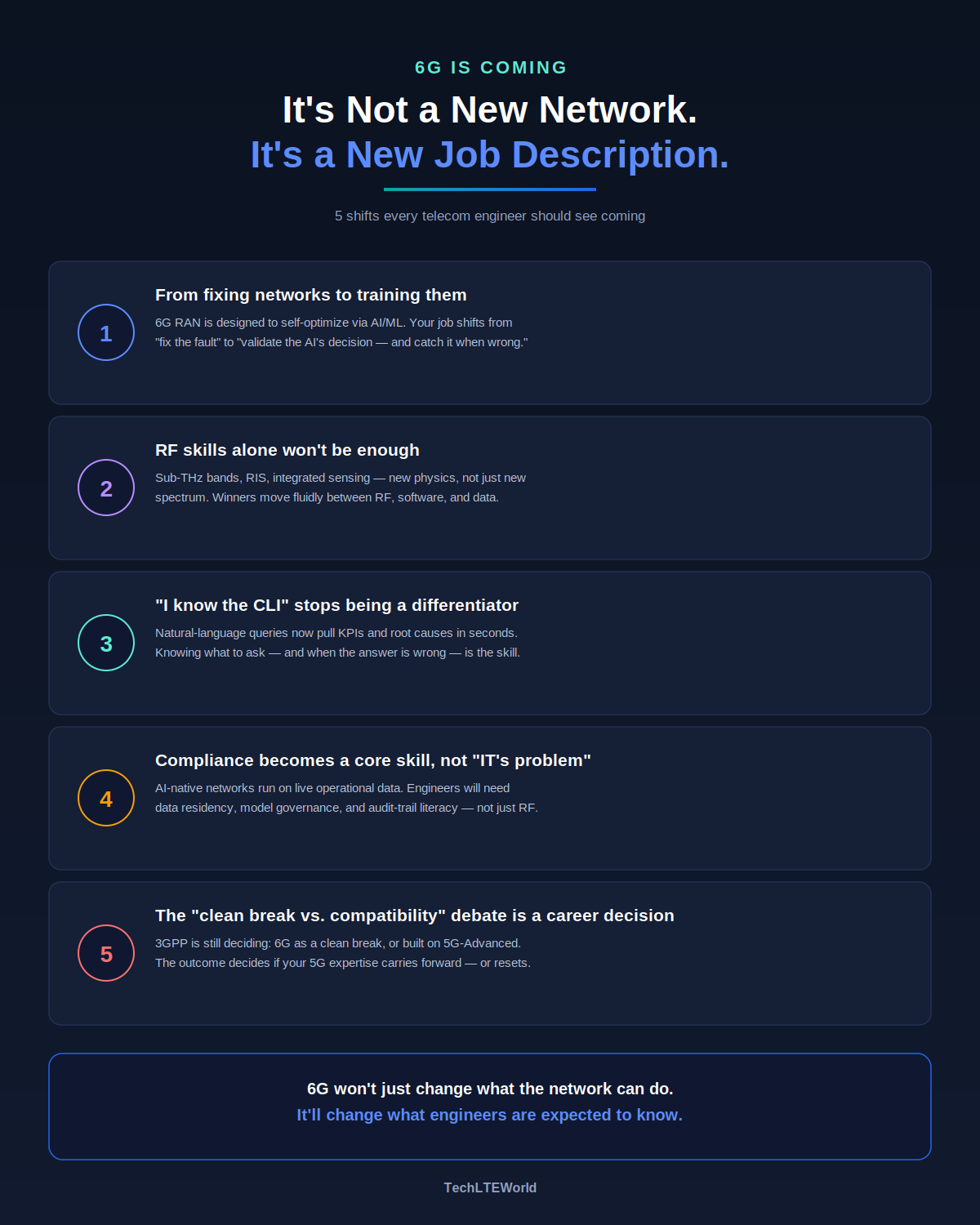
1. You won’t just troubleshoot networks. You’ll train them.
6G networks are being designed to self-optimize using AI/ML at the RAN level. That means the engineer’s job shifts from “fix the fault” to “validate what the AI decided, and correct it when it’s wrong.” If you don’t understand how the model reasons, you can’t catch when it’s wrong.
2. RF skills alone won’t be enough anymore.
Sub-THz bands, RIS (Reconfigurable Intelligent Surfaces), integrated sensing - these aren’t just new spectrum, they’re new physics. The engineers who thrive will be the ones comfortable moving between RF, software, and data.
3. “I know the CLI” stops being a differentiator.
When natural-language queries can pull KPIs, alarms, and root-cause analysis in seconds, typing commands fast isn’t the skill anymore. Knowing what to ask- and knowing when the answer is wrong- is.
4. Compliance and data governance become core skills, not IT’s problem.
AI-native networks run on live operational data. Engineers working with these systems will increasingly need to understand data residency, model governance, and audit trails- not just RF parameters.
5. Backward compatibility debates aren’t just standards talk- they’re career decisions.
3GPP is still debating clean-break vs. 5G-Advanced integration for 6G. Whichever way it goes will directly shape whether your 5G expertise carries forward, or whether you’re starting a new learning curve from scratch.
6G won’t just change what the network can do. It’ll change what engineers are expected to know -and a lot of that shift is already happening, not five years away.
Are you actively upskilling for this shift already - AI/ML, RIS, sub-THz - or is your team still waiting for 6G to “officially arrive” before preparing?