Beam sweeping is one of the aspects of 5G that I find particularly fascinating. It is an amazing example of how time, frequency, and spatial beamforming come together to make a cellular connection possible.
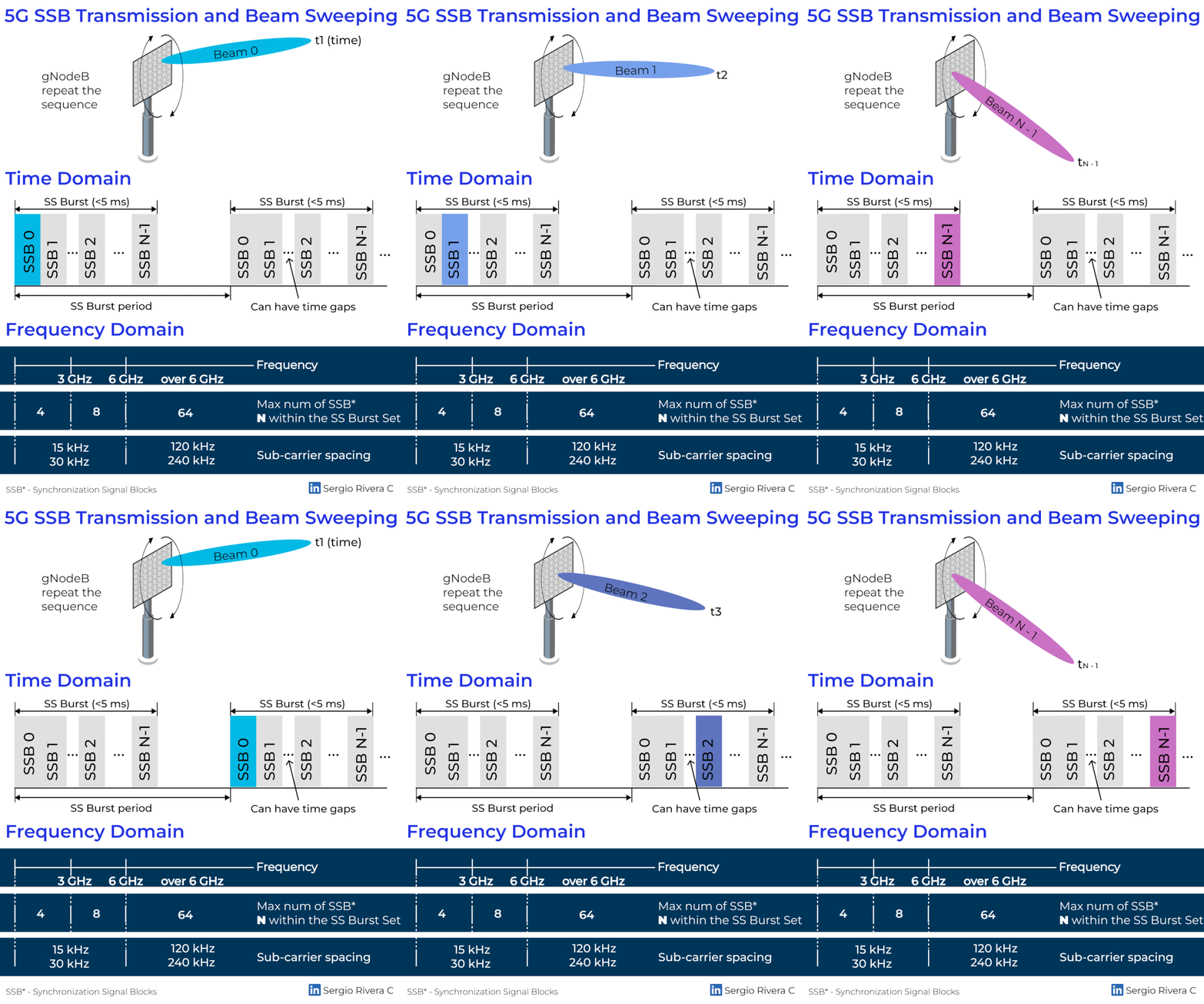
The infographic helps visualize how Synchronization Signal Blocks are transmitted as the gNodeB sweeps its beams across the sector.
In LTE, synchronization signals were transmitted continuously using relatively wide antenna patterns, allowing broad sector coverage.
5G introduced a very different approach.
Modern gNodeBs use beamforming to concentrate radio energy into narrow, directional beams. This provides higher antenna gain and better signal quality, but a narrow beam cannot cover an entire sector simultaneously.
The solution is beam sweeping.
The gNodeB transmits Synchronization Signal Blocks, or SSBs, sequentially in different spatial directions:
Beam 0 → Beam 1 → Beam 2 → … → Beam N-1
The antenna system electronically changes its beam direction between transmissions, progressively scanning the coverage area.
From the UE perspective, these SSB transmissions allow the device to discover and synchronize with the cell. The UE can detect multiple SSBs and evaluate their signal strength, with the strongest beam providing an important reference for subsequent radio procedures.
What makes this mechanism especially interesting is the combination of three dimensions:
 Time - beams are transmitted sequentially.
Space - each beam points in a different direction.
Frequency - the maximum number of SSBs depends on the operating frequency.
All SSBs in a sweep form an SS Burst Set, transmitted within a 5 ms window. The burst can then repeat periodically according to the network configuration.
Frequency also changes the beam strategy.
Sub-3 GHz networks generally use fewer, wider beams.
Mid-band deployments can use more beams to achieve greater spatial resolution and gain.
At mmWave frequencies, much narrower beams can require dozens of SSBs to cover the same area.
A simple analogy is a lighthouse: instead of illuminating the entire ocean continuously, it concentrates its energy into a narrow beam that sweeps across the horizon.
This is one of the aspects of 5G that I find particularly fascinating. Behind what appears to be a simple connection on a smartphone, there is an intricate choreography of time, frequency, and spatial beamforming happening within milliseconds.
And this is exactly what I wanted to capture with this animation: making that invisible choreography visible.
 𝗥𝗲𝗹𝗮𝘁𝗲𝗱 𝗿𝗲𝗮𝗱𝗶𝗻𝗴
Article: 5G Beam Management: Multi-Beam Connectivity
Article: Finding the Signal: Cell Acquisition and Beam Sweeping in 5G
𝗦𝗲𝗿𝗴𝗶𝗼’𝘀 𝗧𝗲𝗰𝗵 𝗕𝗶𝘁𝗲𝘀
LinkedIn: 