Understanding how a User Equipment (UE) moves between states is fundamental for anyone working on network optimization and signaling.
Here is a breakdown of the three primary states that keep our devices connected and power-efficient:
-
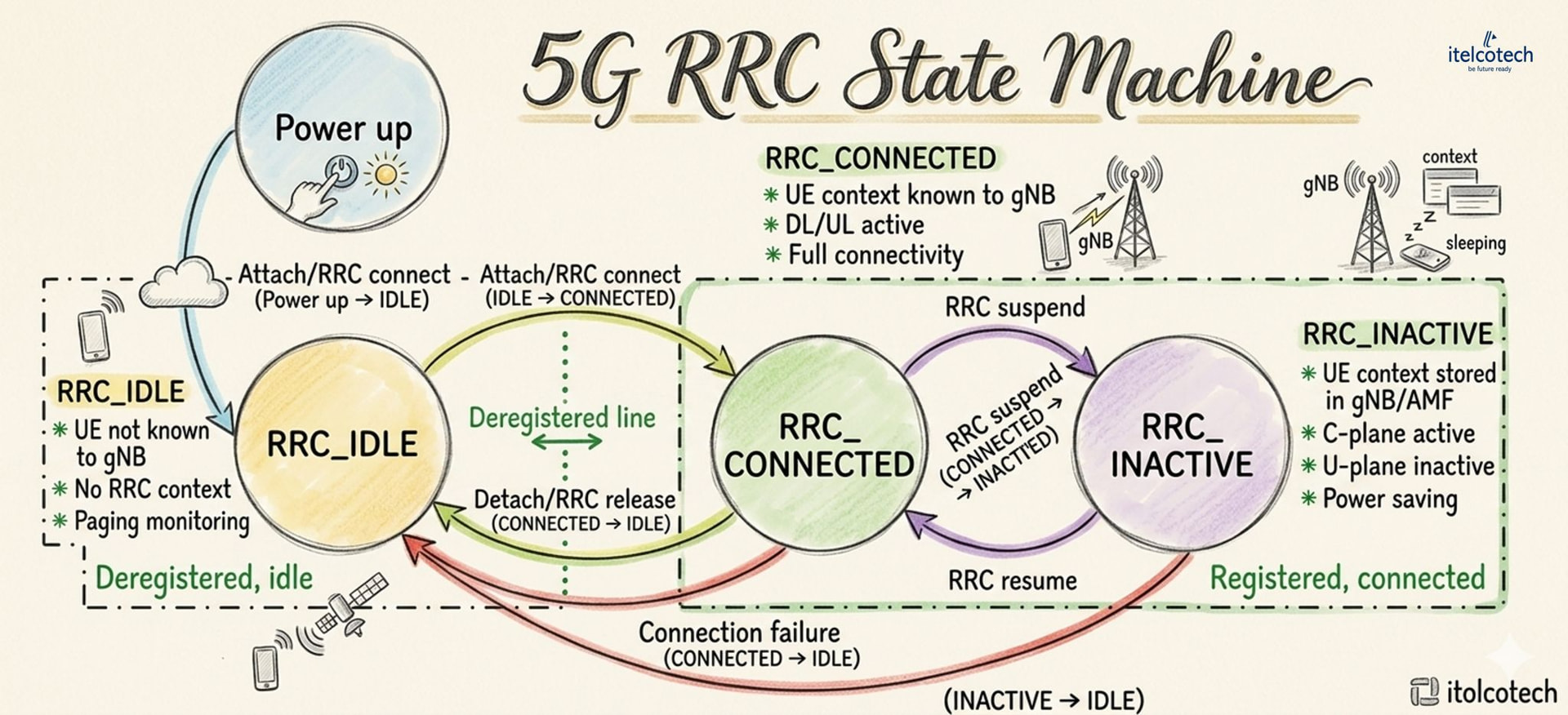
RRC_IDLE: The Starting Point
Status: The UE is not known to the gNB and has no active RRC context.
Activity: The device primarily monitors paging channels to stay reachable while saving maximum battery.
Transition: Moves to Connected via the Attach/RRC connect procedure. -
RRC_CONNECTED: Full Speed Ahead
Status: Full connectivity is established! The UE context is known to the gNB.
Activity: Active Uplink (UL) and Downlink (DL) data transfer is taking place.
Optimization: When data flow stops, the network can trigger an RRC suspend to move the UE into a more efficient state. -
RRC_INACTIVE: The 5G Game Changer
Status: The “sleeping” state where the UE context is stored in the gNB/AMF, even though the U-plane is inactive.
Why it matters: It allows for a lightning-fast RRC resume, drastically reducing signaling overhead and latency compared to starting from Idle.
Key Takeaway: The balance between Power Saving and Instant Connectivity is what makes 5G so robust. Whether it’s a routine RRC release or a critical connection failure, the state machine ensures the UE always knows its path back to the network.
LinkedIn: 