 Simple View First
Think of QoS as:
 Traffic control system of 5G
It decides:
 Which data goes first
Which gets higher priority
How much bandwidth is allocated
 QoS in 5G (3GPP View)
As per 3GPP TS 23.501 (Clause 5.7):
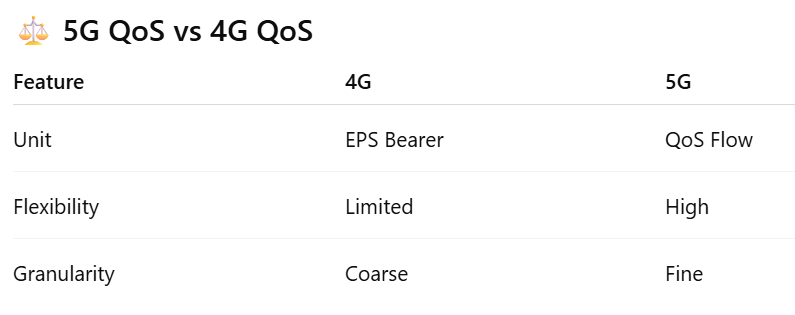
 5G uses QoS Flows (not EPS bearers like 4G)
Each flow is identified by:
5QI (5G QoS Identifier)
ARP (Allocation & Retention Priority)
GBR / Non-GBR attributes
 What is a QoS Flow?
A QoS Flow = logical data stream with specific QoS treatment
 Defined in 3GPP TS 23.501:
A QoS Flow is the finest granularity of QoS differentiation in 5G.
What is 5QI?
5QI = Predefined QoS profile
It defines:
Priority level
Packet delay budget
Packet error rate
GBR vs Non-GBR
 GBR (Guaranteed Bit Rate)
Reserved bandwidth
Used for voice/video
Non-GBR
Best effort
Used for internet browsing
How QoS is Applied (End-to-End)
Let’s follow the flow:
Step 1 — Policy Decision
 PCF → SMF (N7)
Defines QoS rules
Step 2 — Session Setup
SMF assigns QoS Flows
Maps:
-
5QI
-
GBR/Non-GBR
Step 3 — UPF Enforcement
 UPF enforces QoS
Via QER (QoS Enforcement Rule)
Step 4 — RAN Mapping
 gNB maps QoS Flow → DRB
Refer: 3GPP TS 23.501 & TS 38.300 (RAN mapping)
 End-to-End Path
 UE → gNB → UPF →
  DN
DN
QoS is maintained across entire path
Simple Analogy
QoS = Airport Priority System
-
Business class → High priority
-
Economy → Normal
-
Cargo → Lowest
For real-world 5G:
QoS enables:
VoNR quality
Gaming performance
Enterprise SLAs
Network slicing
 Key 3GPP Takeaway
“QoS in 5G is flow-based, with each QoS Flow identified by a 5QI and enforced across RAN and Core.” — 3GPP TS 23.501
 In Simple Words
QoS = Who gets priority in the network