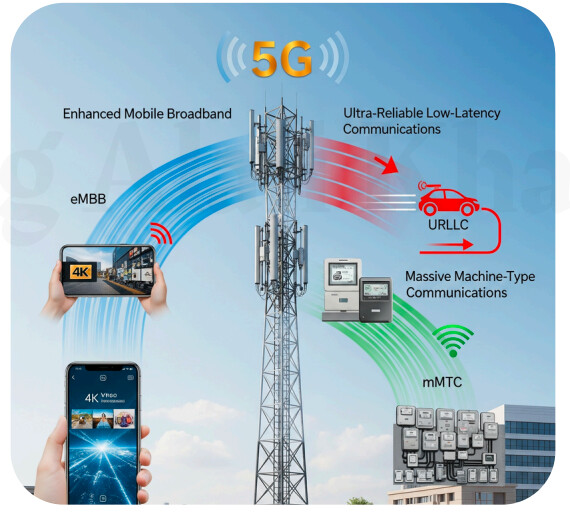
How can a single 5G network stream flawless 4K video and deliver millisecond-level reaction time to an autonomous car or factory robot?
The answer lies deep in the physical layer design through a powerful feature called Flexible Numerology.
Instead of one-size-fits-all, 5G can dynamically reshape the radio waveform using different subcarrier spacing, slot durations, and mini-slot scheduling tailored to each use case, in real time.
 In my latest in-depth article, I break down the core mechanisms that make this possible, Here’s what you’ll learn:
-
The trade-off between Subcarrier Spacing (SCS) and symbol duration and how it affects latency and interference.
-
Why higher SCS is used for fast-moving users and mmWave to mitigate Doppler and Phase Noise.
-
How Bandwidth Parts (BWP) allow a single UE to switch between numerologies, saving power and adapting to service type.
-
How Mini-Slot Preemption enables URLLC to interrupt ongoing transmissions and meet strict latency needs.
-
A visual breakdown of the 5G slot structure from 1 to 16 slots per subframe depending on SCS.
Perfect for: RF engineers, DSP students, 5G system architects,…or anyone curious about how 5G actually works
Read the full article here 
PDF: 
5G Numerology (by Alali Khalaf).pdf (7.3 MB)
LinkedIn: