5G Network Slicing Deep Dive

  • Evolution of Network Slicing.
  • ITU Framework for Network Slice.
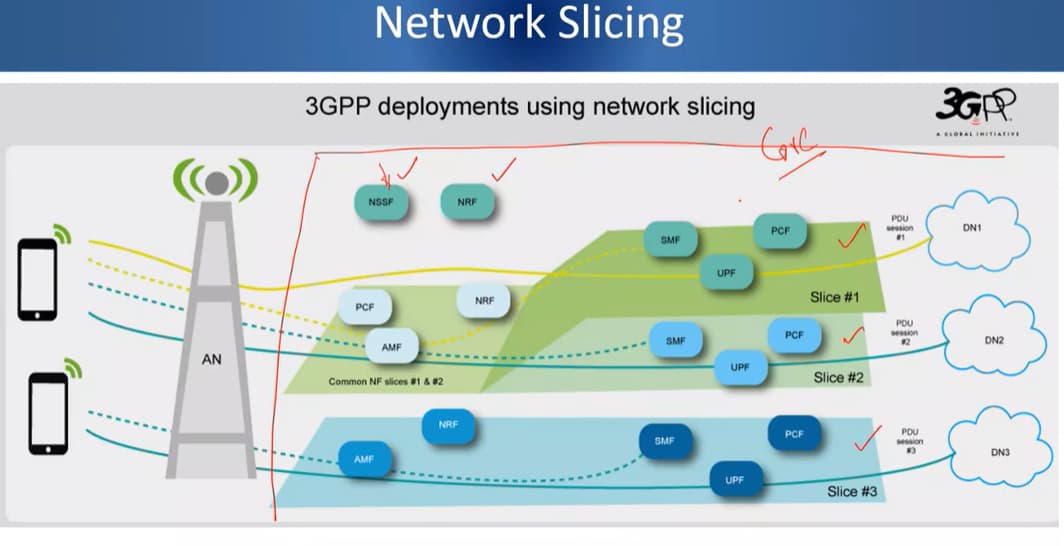
  • Concept of Network Slicing,
  • Network functions from the UE perspective,
  • Use case – Autonomous car,
  • 3GPP Evolution of Network Slicing,
  • Service and Operational Requirement for Network Slicing,
  • QoS Flows and Network Slices,
  • Network Functions to Support Network Slice,
  • Network Slice Selection Function (NSSF),
  • Network Slice Specific Authentication and Authorization Function (NSSAAF),
  • Network Slice Admission Control Function (NSACF),
  • Slice Identifier ,
  • Standard Value of SST,
  • Default / Configured NSSAI,
  • Rejected NSSAI,
  • Limit of slices / PDU Sessions for UE,
  • Network Slice Simultaneous Registration Group (NSSRG),
  • Support of data rate limitation per Network Slice for a UE,
  • RAN Slicing (Rel 17) ,
  • Network Slice AS Groups ,
  • Network slicing and Interworking with EPS,
  • Network Slice Template by GSMA

Watch Video on YouTube: :point_right: https://www.youtube.com/watch?v=GwZnhQPTVwk
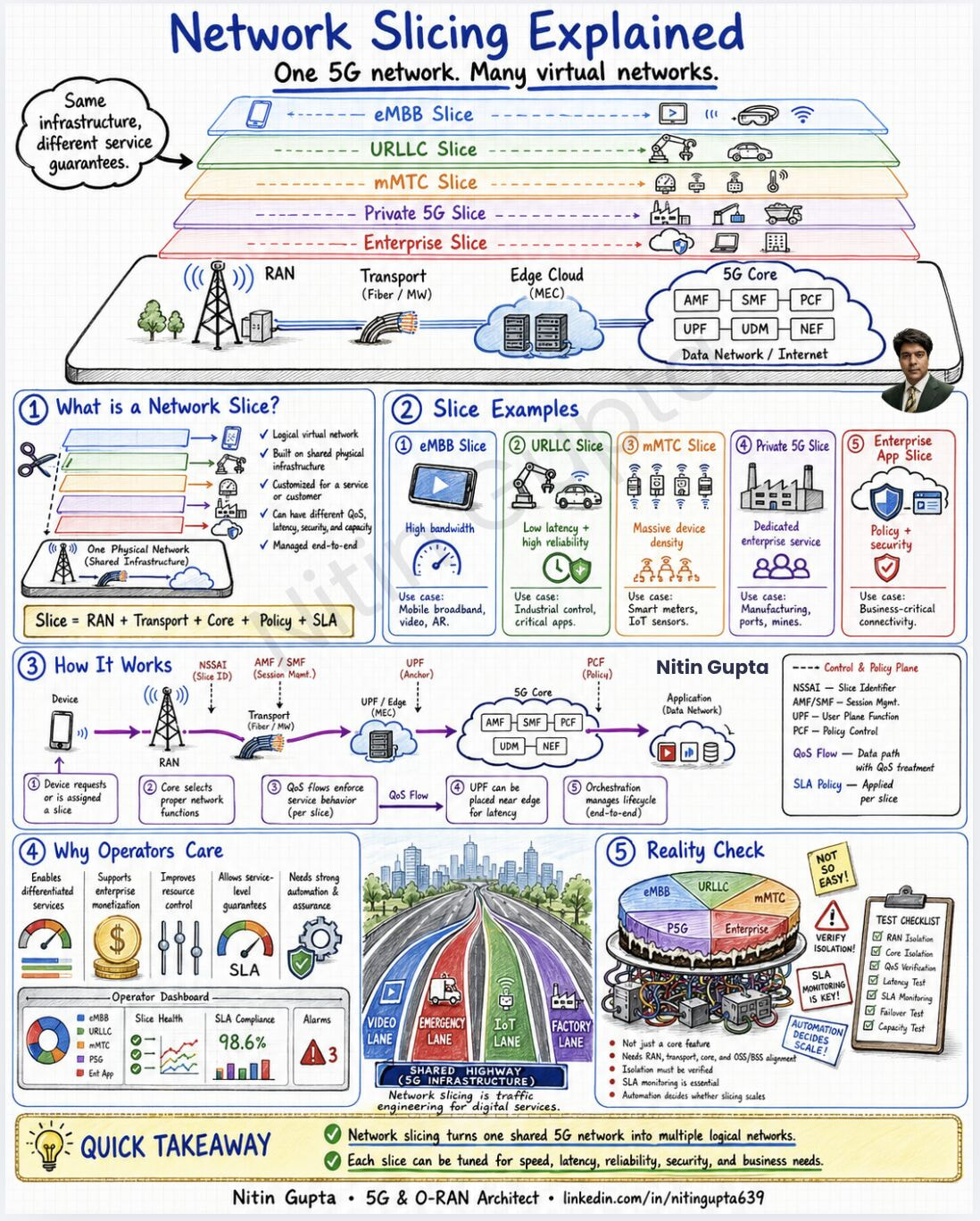
One 5G network.
Many virtual networks.

That is the core idea behind network slicing.

Instead of building separate physical networks for every service, 5G allows operators to create logical slices over shared infrastructure.

Each slice can be tuned for a different requirement:

High bandwidth
Low latency
Massive device density
Private enterprise connectivity
Security
Reliability
SLA assurance

Examples:

eMBB slice
For mobile broadband, video, AR/VR and high data rates.

URLLC slice
For low-latency and high-reliability use cases like robotics, critical apps and industrial control.

mMTC slice
For massive IoT, sensors, smart meters and low-power devices.

Private 5G slice
For factories, ports, mines and enterprise networks.

Enterprise app slice
For business-critical connectivity with policy and security.

A network slice is not only a “Core feature.”

It touches the full path:

RAN
Transport
Edge Cloud
5G Core
Policy
QoS
SLA monitoring
Automation

Simple formula:

Slice = RAN + Transport + Core + Policy + SLA

This is why network slicing is powerful, but also complex.

Operators care because slicing can enable:

Differentiated services
Enterprise monetization
Resource control
Service-level guarantees
Better assurance
Automation at scale

But the reality check is important:

Slicing must be verified end-to-end.

RAN isolation
Core isolation
QoS verification
Latency testing
SLA monitoring
Failover testing
Capacity testing

Network slicing is not just about creating a virtual lane.

It is about guaranteeing the right experience on that lane.

Quick takeaway:

Network slicing turns one shared 5G network into multiple logical networks.

Each slice can be tuned for speed, latency, reliability, security and business needs.

LinkedIn: :backhand_index_pointing_down: