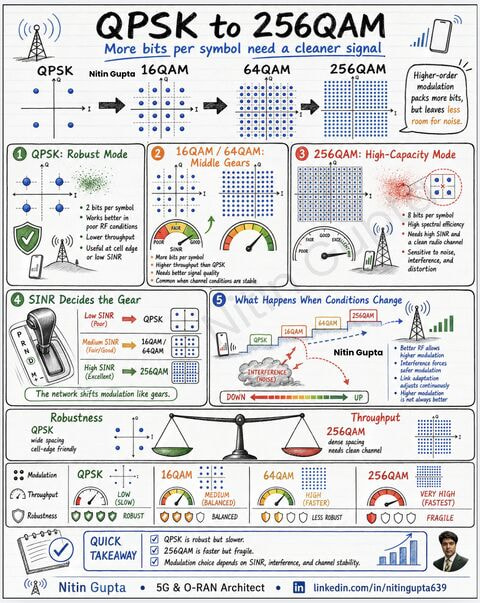
QPSK to 256QAM explains one simple truth in 5G:
More bits per symbol need a cleaner signal.
1. QPSK
QPSK is the robust mode.
It carries fewer bits per symbol, but it works better when radio conditions are weak.
Useful for:
- Cell edge
- Low SINR
- Poor RF conditions
- Stable but lower throughput
2. 16QAM and 64QAM
These are the middle gears.
They carry more bits per symbol than QPSK and improve throughput when the channel is reasonably clean.
Useful when:
- SINR is fair to good
- Interference is controlled
- Channel conditions are stable
3. 256QAM
256QAM is the high-capacity mode.
It carries 8 bits per symbol and can deliver very high throughput.
But it needs:
- High SINR
- Clean radio channel
- Low interference
- Stable channel quality
4. How the network decides
The network does not randomly choose modulation.
It adapts based on radio quality.
- Low SINR → QPSK
- Medium SINR → 16QAM / 64QAM
- High SINR → 256QAM
5. Key point
Higher modulation is faster.
But higher modulation is also more fragile.
If the channel is noisy, using 256QAM can create more errors, retransmissions, and unstable throughput.
Quick takeaway:
- QPSK = robust but slower
- 16QAM / 64QAM = balanced
- 256QAM = very fast but needs a clean signal
In mobile networks, speed is not only about bandwidth.
It is also about SINR, interference, and channel stability.
LinkedIn: 