Your smartphone today is not just connected to a network…
It is connected to decades of wireless innovation.
From 4G enabling mobile broadband
to 5G powering smart cities and IoT
to 6G promising AI-native intelligent networks.
But many professionals still ask:
 What really changed between 4G, 5G, and 6G?
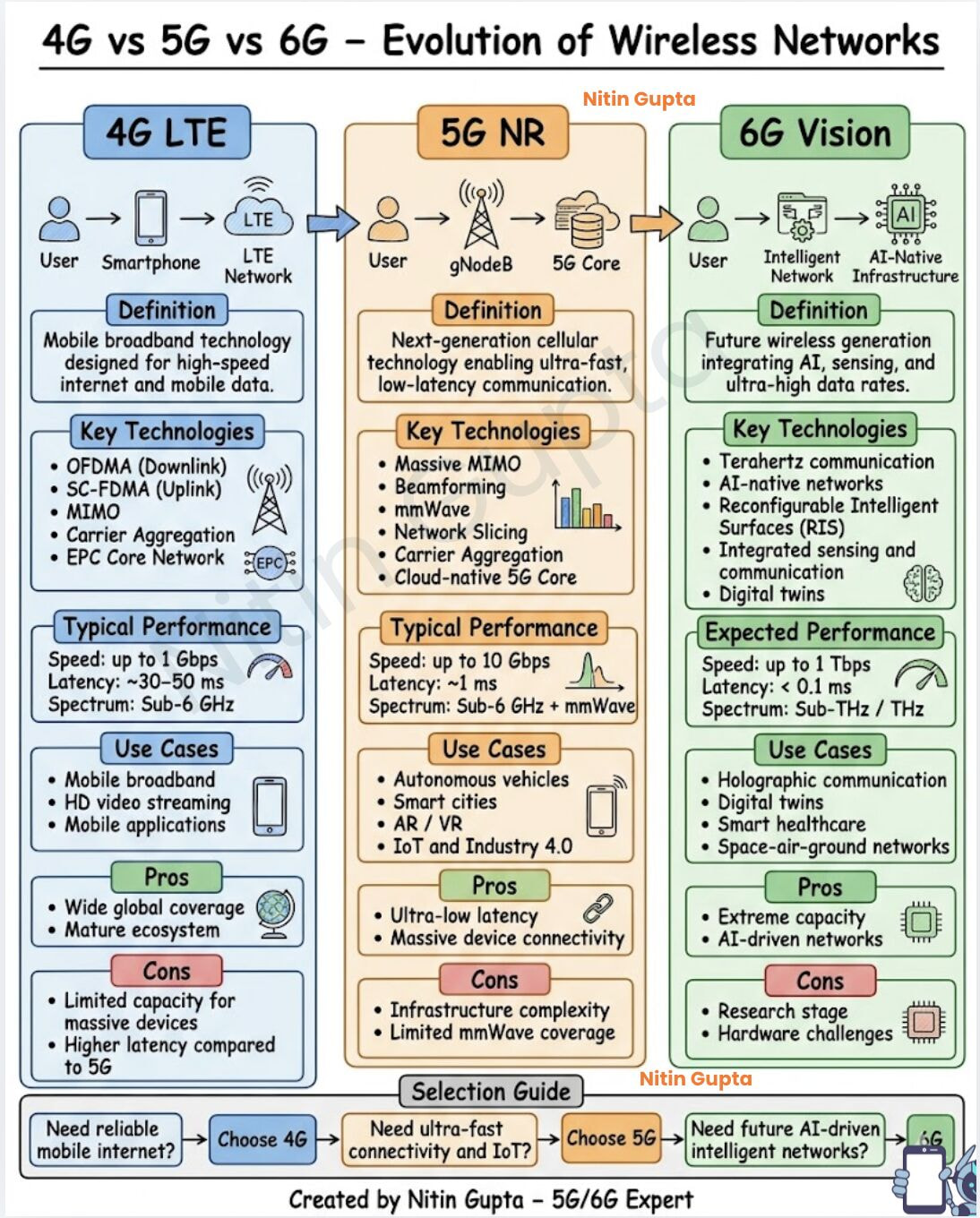
So I created a simple visual cheat sheet to explain the evolution of wireless networks.
Here are the key highlights 
 4G LTE – The Mobile Broadband Era
• Designed for high-speed mobile internet
• Technologies: OFDMA, MIMO, Carrier Aggregation
• Speed: up to 1 Gbps
• Latency: 30–50 ms
Use cases:
 Mobile apps
 HD video streaming
 Mobile broadband
4G made the smartphone revolution possible.
 5G NR – The Intelligent Connectivity Era
• Ultra-fast and ultra-reliable communication
• Technologies: Massive MIMO, Beamforming, mmWave, Network Slicing
• Speed: up to 10 Gbps
• Latency: around 1 ms
Use cases:
 Autonomous vehicles
 Smart cities
 AR/VR
AR/VR
 Industry 4.0
5G connects billions of devices and machines.
 6G – The Future AI-Native Network
• AI-driven, intelligent wireless infrastructure
• Technologies: Terahertz communication, RIS, integrated sensing
• Speed: up to 1 Tbps
• Latency: <0.1 ms
Future use cases:
Holographic communication
 Digital twins
 Smart healthcare
 Space-air-ground networks
6G will connect the physical, digital, and intelligent worlds.
 In simple terms
4G → Connect People
5G → Connect Everything
6G → Connect Intelligence
 As telecom engineers, researchers, and innovators…
We are not just building networks.
We are building the infrastructure of the future digital society.
I’m curious:
Which technology excites you the most for the future?
• 4G evolution
• 5G advanced
• 6G intelligent networks
Share your thoughts in the comments.
Linkedin: