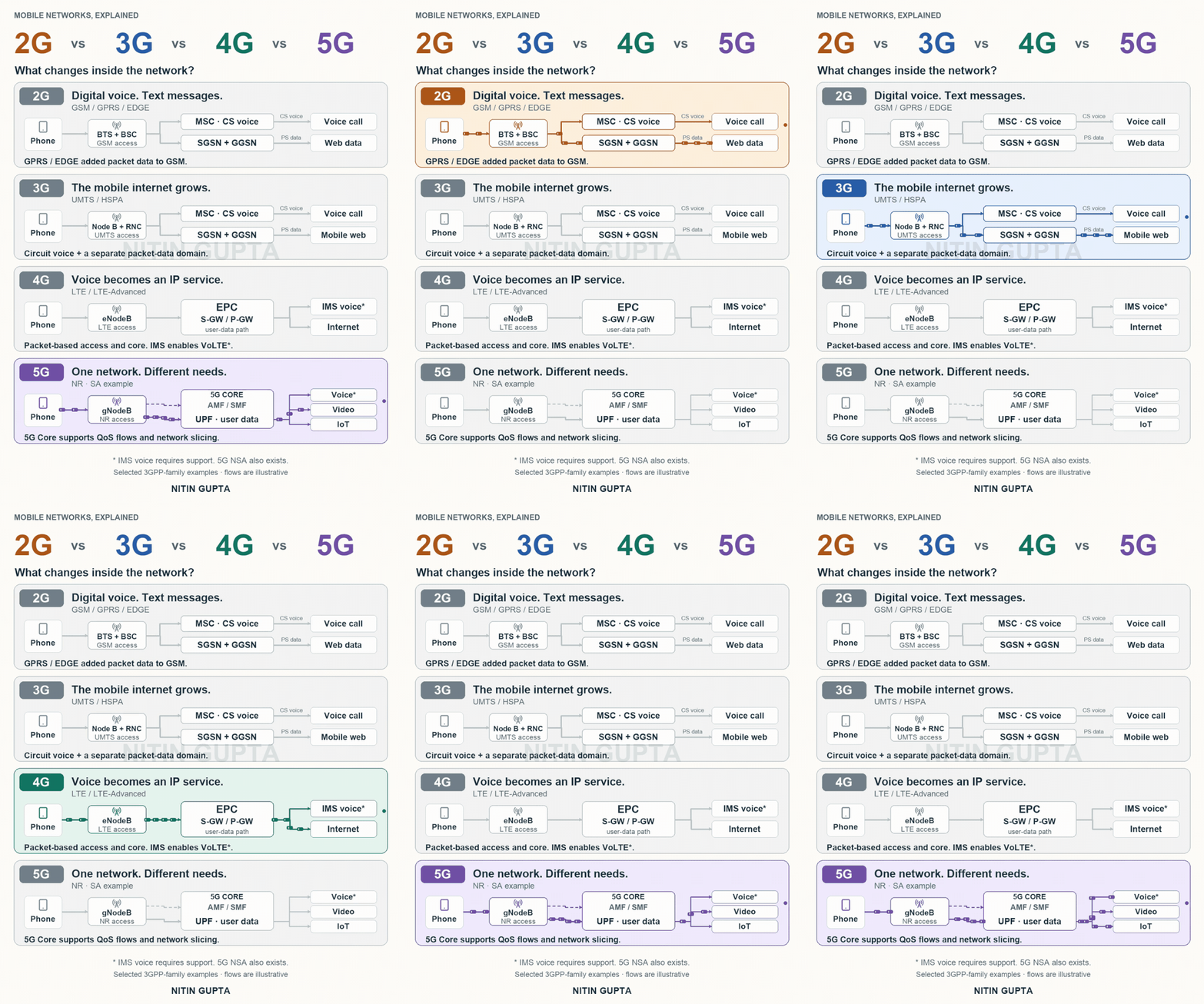
Every generation changes how your phone connects, how traffic travels and how services are delivered. This animation follows those changes through four simplified network examples.
⠀
◆ 2G: digital voice and messaging
GSM brought digital calling and SMS to the mass market. GPRS and EDGE added packet-data services, so 2G was never limited to calls and texts. The animation separates the circuit-switched voice path from the packet-data path.
⠀
◆ 3G: mobile internet expands
UMTS and HSPA developed mobile packet-data services further. In the example shown, Node B and the Radio Network Controller connect users to circuit-switched voice and packet-switched data domains. Mobile data existed before 3G; 3G expanded what people could do with it.
⠀
◆ 4G: a packet-based network
LTE connects the phone through an eNodeB to the Evolved Packet Core. Internet traffic travels as packets. With operator and device support, the IP Multimedia Subsystem enables Voice over LTE—VoLTE—over that packet-based network.
⠀
◆ 5G: connectivity for different service needs
The standalone example connects New Radio to the 5G Core. The User Plane Function carries user traffic, while separate control functions manage access and sessions. Quality-of-service flows and network slicing support differentiated services when configured and supported.
⠀
Watch the moving markers: circles illustrate circuit voice, while rectangles illustrate packet traffic. Their motion explains the paths; it does not represent measured speed or latency.
⠀
Two distinctions matter: 5G also has non-standalone deployments, and voice availability depends on network and device support. A 5G icon does not automatically mean a standalone connection or a VoNR call.
⠀
This is a simplified, 3GPP-informed comparison of selected architectures. It shows how the network evolves beyond the generation label on your screen.
LinkedIn: 