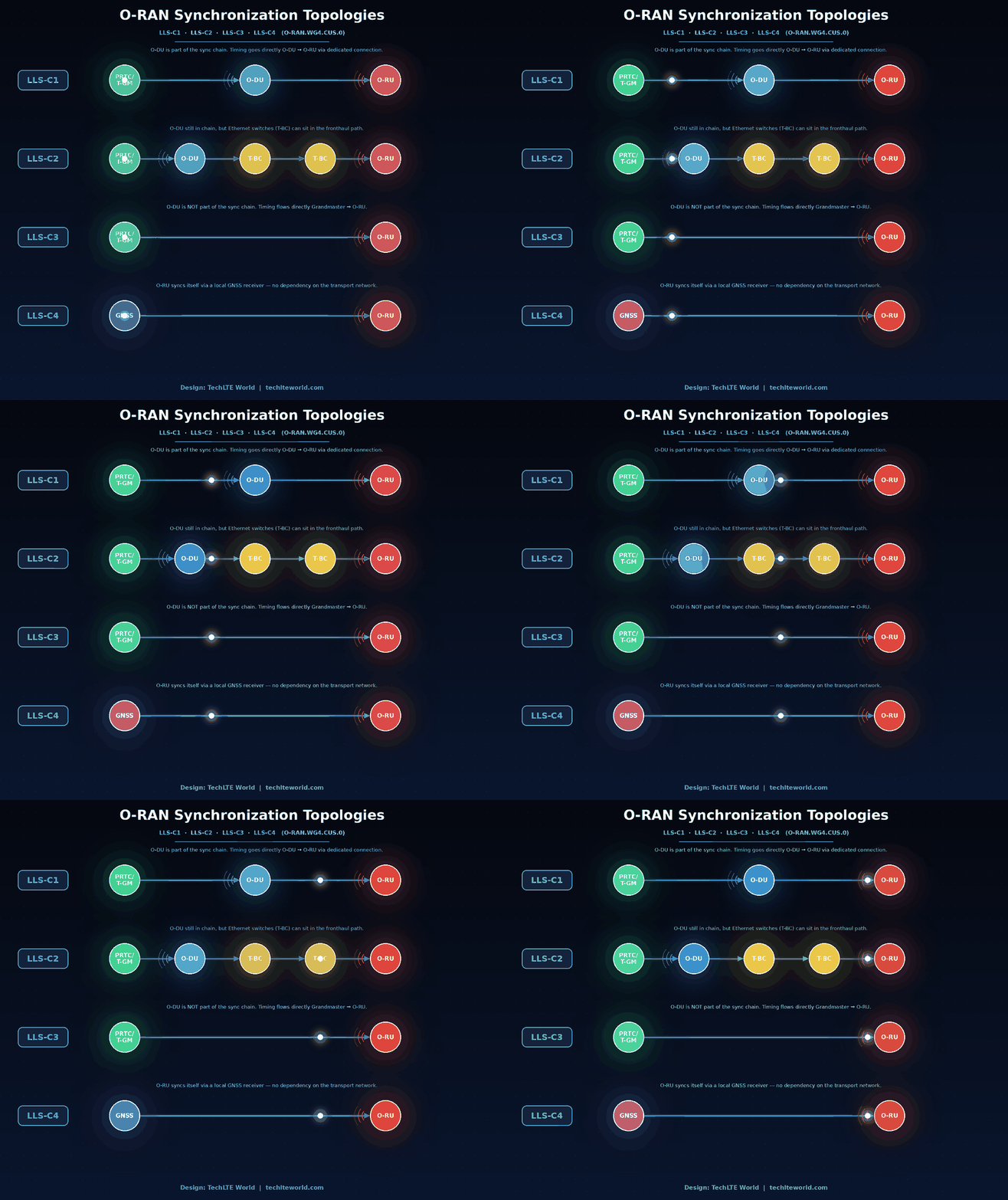
Sharing a simple O-RAN synchronization based on the O-RAN.WG4.CUS.0 spec-sounds complicated at first, but it’s basically just different ways of getting the correct time from one point to the O-RU.
Why timing even matters
Every O-RU in the network needs to know the exact same time. If timing is off even slightly, radio signals from different cells can interfere with each other, data can get messed up, and networks can fail regulatory timing rules. So getting this right is a big deal.
4 Ways to Sync (LLS-C1 to LLS-C4)
Think of these as 4 different “paths” the time signal can take to reach the O-RU:
- LLS-C1 — Straight line, no stops
Timing goes directly: Grandmaster Clock → O-DU → O-RU. Simple, no switches involved. - LLS-C2 — Same path, but with a few stops
Same as above, but now there can be Ethernet switches in between (called T-BC). The catch: you can’t add unlimited switches each one adds tiny timing errors, so there’s a limit (usually around 2 switches with good hardware) before the total error becomes too much. - LLS-C3 — Skip the O-DU entirely
Here, timing goes directly from the Grandmaster Clock straight to the O-RU, without passing through the O-DU at all. - LLS-C4 — O-RU does its own thing
The O-RU doesn’t rely on the network for timing at all it has its own local GPS/GNSS receiver and gets time directly from satellites.
How the O-DU itself gets synced is a totally separate question- it doesn’t affect which of these 4 topologies you’re using. The topology is just about how timing flows from source to O-RU.
Website  Clock model and synchronization topology in ORAN