Ever wondered why two LTE users in the exact same spot can get very different speeds? A big part of the answer is Transmission Mode ™.
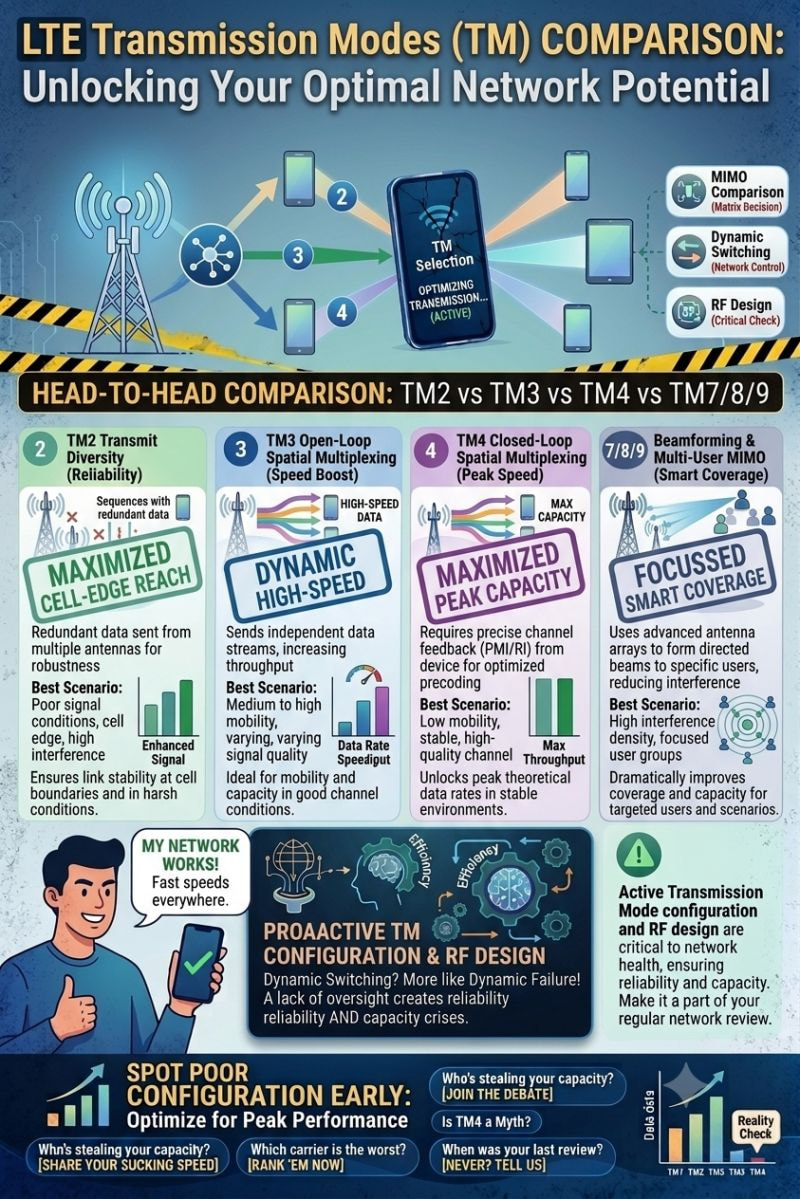
LTE defines multiple TMs, each shaping how the eNB uses its antennas to talk to a UE. A quick breakdown of the ones that matter most in the field:
→ TM1 (Single Antenna Port): The baseline. One antenna, no diversity, no MIMO gain. Simple, but leaves performance on the table.
→ TM2 (Transmit Diversity): Uses multiple antennas to send the same data redundantly, improving reliability at the cell edge where SINR is weak. Robustness over raw throughput.
→ TM3 (Open-Loop Spatial Multiplexing): Sends independent data streams across antennas without detailed channel feedback from the UE. Good for higher-mobility users where channel conditions change too fast for closed-loop feedback to stay accurate.
→ TM4 (Closed-Loop Spatial Multiplexing): Similar to TM3, but uses precise channel feedback (PMI/RI) from the UE to optimize the precoding. Higher peak throughput, but needs a stable channel and good feedback quality.
→ TM7/8/9 (Beamforming / Dual-Layer Beamforming): Focuses energy directly toward the UE using dedicated reference signals, extending coverage and improving SINR — especially valuable in dense urban deployments with high interference.
Here’s the part that matters for RF optimization: TM selection isn’t static. The network dynamically switches between modes based on real-time channel conditions, or it’s configured per scenario during design. Get it wrong, and you either leave throughput on the table (using diversity mode when spatial multiplexing was possible) or hurt cell-edge reliability (pushing spatial multiplexing where the channel can’t support it).
Good RF design isn’t just about coverage and capacity numbers on a map. It’s about ensuring the network is making the right MIMO decision, cell by cell, moment by moment.
LinkedIn: 