How Felicia ™ Works End-to-End — From Network Problem to Engineering Delivery
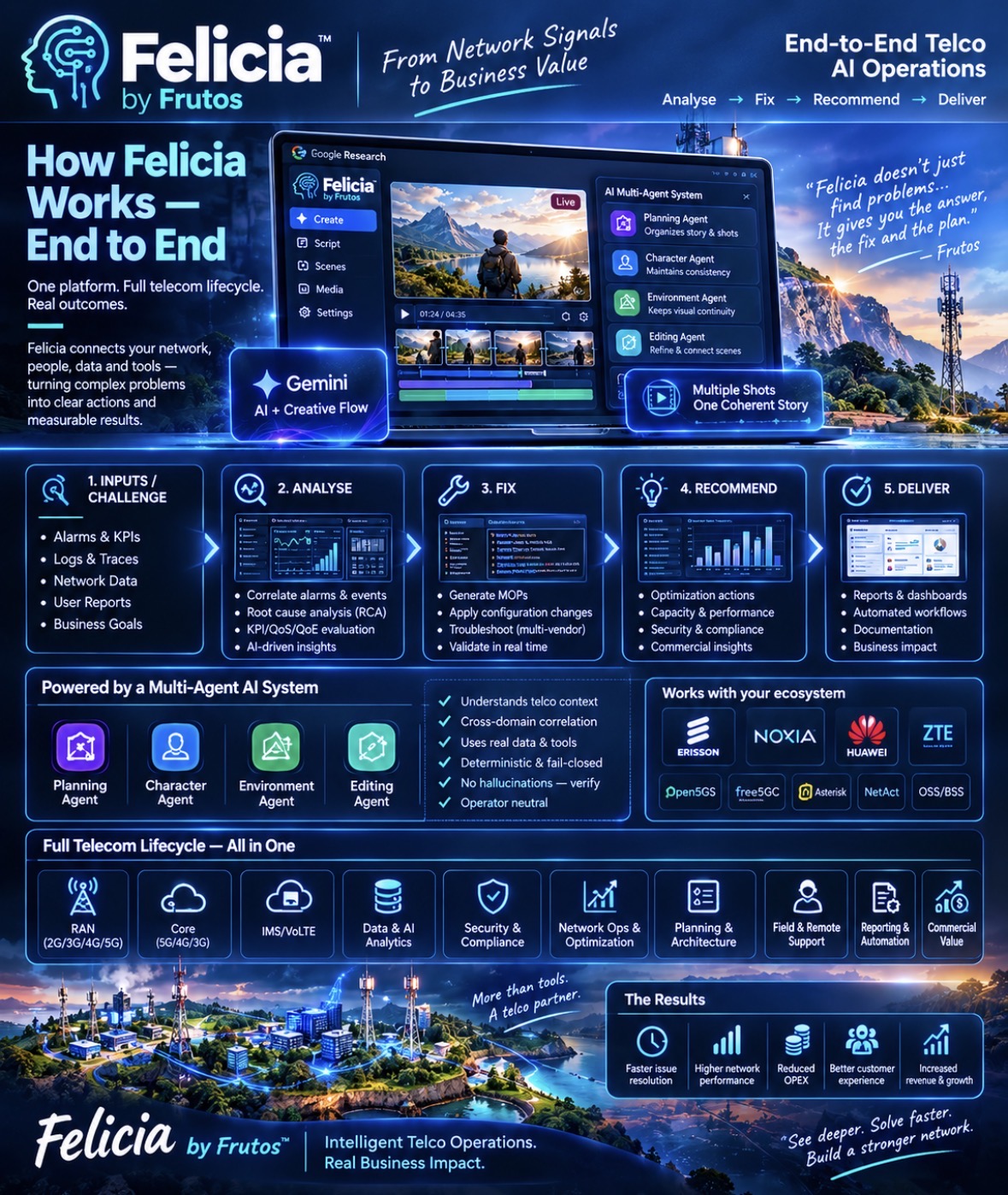
A telecom problem normally starts with fragmented evidence: alarms, KPIs, logs, traces, configuration data, customer reports or a business requirement.
Felicia is designed to turn that evidence into a verified engineering delivery through five stages:
1. INPUT / CHALLENGE
Alarms • KPIs • Logs • Traces • Network data • User reports • Business goals
2. ANALYSE
Correlate events → identify patterns → perform RCA → evaluate KPI/QoS/QoE → establish the evidence.
3. FIX
Troubleshoot → generate MOPs → propose/apply configuration changes → validate the technical result.
4. RECOMMEND
Optimization → capacity → performance → security → compliance → architecture → commercial implications.
5. DELIVER
Engineering reports • dashboards • MOPs • documentation • automation • recommendations • decision-ready outputs.
The same workflow can span:
2G/3G/4G/5G RAN | EPC | 5G Core | IMS/VoLTE | OSS/BSS | Security | Planning | Optimization | Remote Support
And across multi-vendor environments including Ericsson, Nokia, Huawei and ZTE, as well as relevant open-source and cloud-native technologies.
The principle is simple:
Don’t stop at the alarm.
Don’t stop at the diagnosis.
Don’t stop at the recommendation.
Deliver the engineering outcome.
Felicia ™ — Analyse → Fix → Recommend → Deliver.