A coverage map can look perfect.
The customer’s journey can tell a different story.
⠀
That is why telecom drive testing matters.
⠀
It is not just driving around with test phones and collecting logs.
⠀
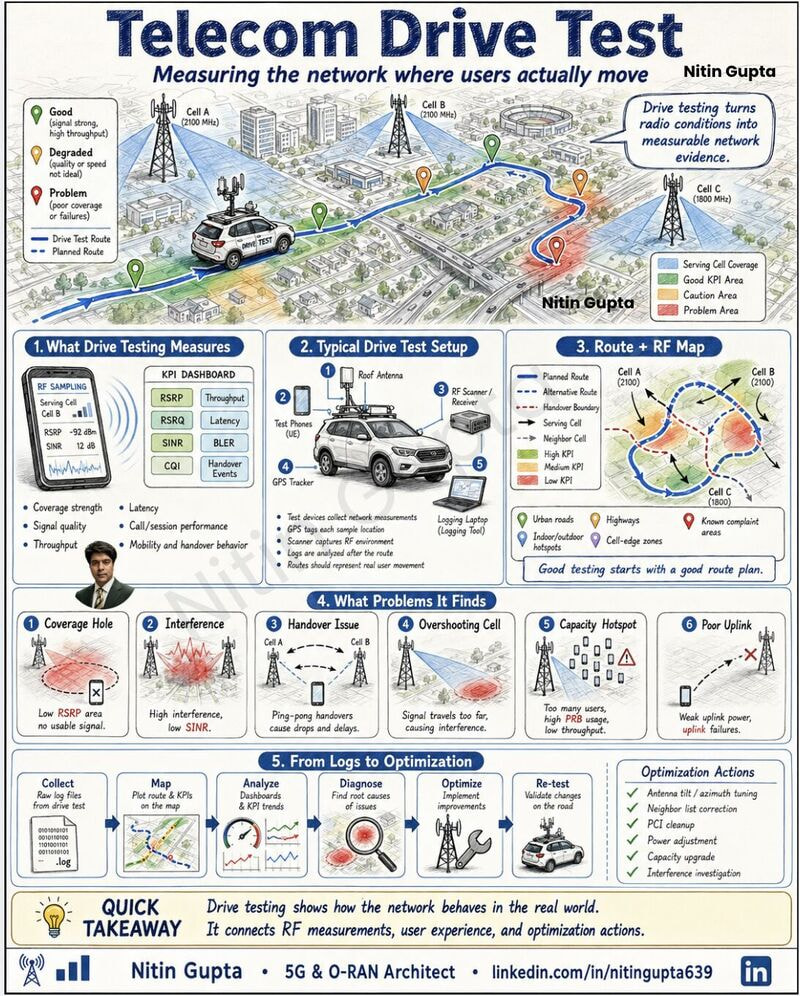
It is connecting radio measurements to what users actually experience:
⠀
● Where does the call drop?
● Why does throughput fall at this junction?
● Does the session survive a handover?
● Why is the uplink struggling despite strong signal bars?
⠀
◆ What engineers measure
⠀
• RSRP: received reference signal power
• RSRQ and SINR: radio-quality indicators
• Throughput and latency: data performance
• BLER: block error performance
• Call, session and handover events: service continuity
⠀
One important distinction:
⠀
Strong signal does not automatically mean good service.
⠀
Interference, congestion, mobility problems or uplink limitations can still affect the experience.
⠀
◆ The real work starts after collection
⠀
Collect → Map → Analyze → Diagnose → Optimize → Re-test
⠀
A red point on a map is a symptom, not a root cause.
⠀
Engineers need to correlate measurements, signaling traces, location and network configuration to understand what happened.
⠀
Then comes the appropriate action: antenna tuning, neighbor corrections, interference investigation or capacity improvements.
⠀
And then another test to check whether the change actually helped.
⠀
◆ A good test needs a good plan
⠀
The route, device, test configuration and time of day all influence the results. One successful drive does not represent every user or every network condition.
⠀
The goal is not simply to produce a KPI report.
⠀
It is to find the gap between the network we planned and the experience we delivered.
LinkedIn: 