Two acronyms.
One shared goal.
Very different paths.
How do devices connect to a network?
There are two ways:
 CBRA – Contention-Based Random Access
 CFRA – Contention-Free Random Access
Same goal.
Very different vibe.
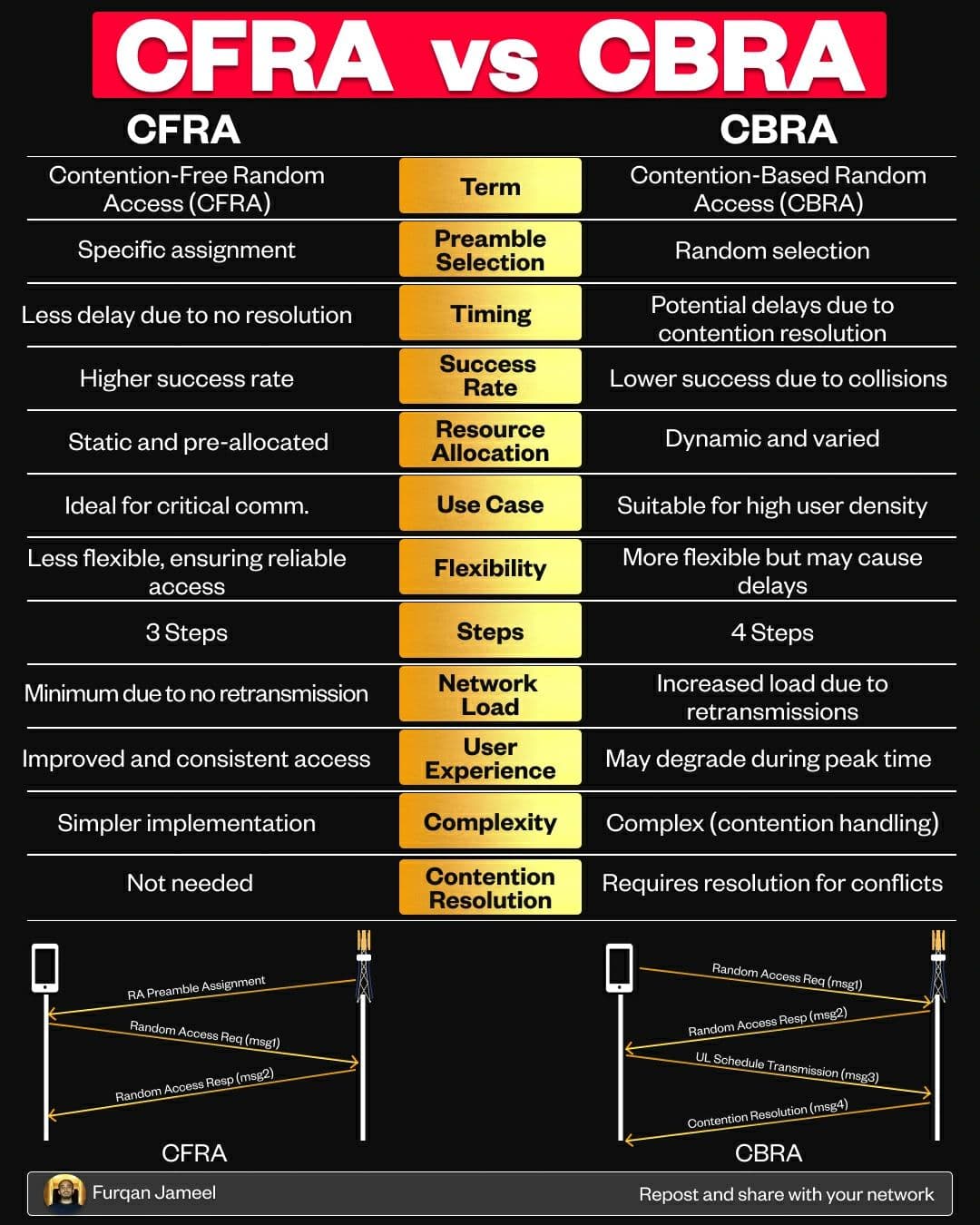
Here’s how they stack up:
• CBRA is messy
Devices compete to connect
CFRA is calm—connections are scheduled
• CBRA is fine with collisions
It can recover from chaos
CFRA avoids them altogether
• CBRA is flexible
Great for general use
CFRA is built for reliability
• CBRA scales fast
Ideal for large, dynamic networks
CFRA thrives in high-stakes, low-latency environments
Both have their place.
If you’re after adaptability or running a massive network:
 CBRA could be your choice.
If every millisecond matters or failure isn’t an option:
CFRA is the clear winner.
But here’s the trap—
Don’t assume the popular option is the right one.
I’ve seen networks struggle not because they lacked resources,
but because they chose the wrong connection logic.
So here’s my take:
Forget trends.
Study your traffic, your latency needs, your risks.
Then choose the method that fits—not the one that’s loudest.
That’s how you build smart, not just fast.
Thanks for reading.
LinkedIn: 