In RF optimization, we often spend most of our time evaluating RSRP, SINR, and RSRQ (especially on my side). While these RF metrics define channel quality, a truly comprehensive analysis shouldn’t stop at identifying and improving the causes of poor SINR—it requires understanding how data is assembled, adapted, and protected across the protocol stack under those degraded conditions.
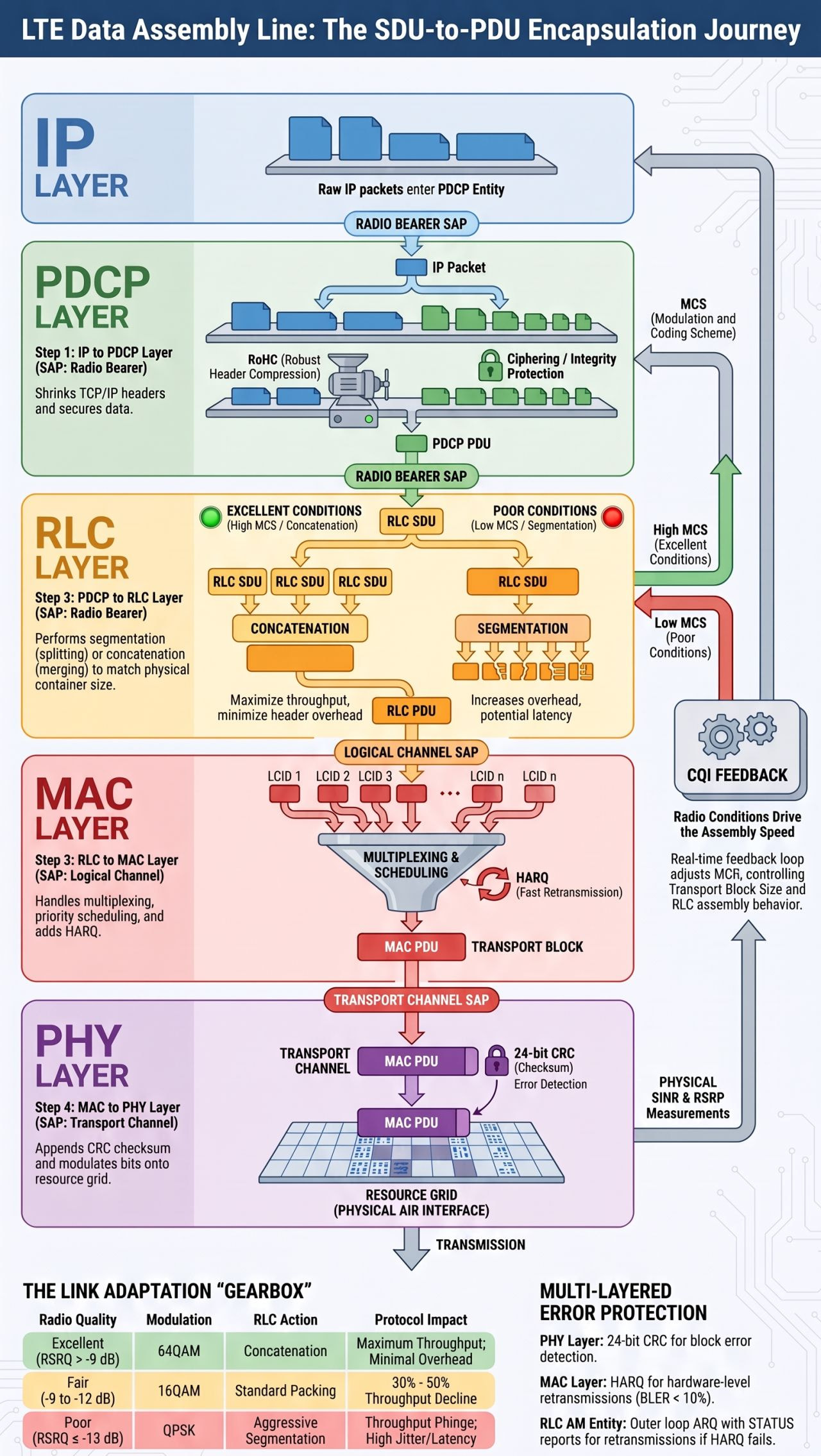
The physical channel directly dictates upper-layer behavior through dynamic link adaptation mapped across 3GPP specifications:
-
PDCP Layer (3GPP TS 36.323): Raw IP packets enter via Radio Bearers, undergoing Robust Header Compression (RoHC) to shrink headers and ciphering/integrity protection to secure user data.
-
RLC Layer (3GPP TS 36.322): Responds directly to link adaptation decisions. Based on the allocated Modulation and Coding Scheme (MCS) derived from channel feedback (CQI/SINR), RLC either performs concatenation (merging multiple SDUs under clean RF to maximize throughput) or segmentation (splitting SDUs into smaller chunks when conditions degrade).
-
MAC Layer (3GPP TS 36.321): The core engine of link adaptation; it translates CQI into an appropriate Transport Block Size (TBS) and MCS, multiplexes logical channels into a single MAC PDU, and schedules transmissions.
-
PHY Layer (3GPP TS 36.211 / TS 36.212): Executes the link adaptation parameters by applying channel coding, CRC attachment, and modulating bits using the assigned scheme (QPSK, 16QAM, 64QAM/256QAM) onto the resource grid.
When SINR degrades, data protection operates across multiple layers:
-
PHY Layer (TS 36.212): Leverages a robust 24-bit CRC for block error detection and shifts to lower-order modulation (such as QPSK) with higher coding redundancy.
-
MAC Layer (TS 36.321): Executes fast, hardware-level HARQ retransmissions to rapidly recover lost blocks (targeting BLER < 10%).
-
RLC AM Entity (TS 36.322): Serves as the outer-loop safety net, using ARQ with STATUS reports to recover any residual packet loss if HARQ exceeds maximum attempts.
A strong RSRP means little if poor SINR forces the eNodeB into low Modulation and Coding Scheme (MCS), triggering aggressive segmentation, increased protocol overhead, and latency.
True optimization requires looking at both sides of the coin: resolving the root causes of RF degradation while understanding the multi-layered encapsulation and protection mechanisms that keeping data intact.
(Reference concept inspired by Wiley’s LTE Signaling, Troubleshooting, and Optimization)
LinkedIn: 