Your phone does not need to use the entire 5G carrier all the time.
Sometimes, using less bandwidth is the smarter choice.
⠀
That is where Bandwidth Parts, or BWPs, come in.
⠀
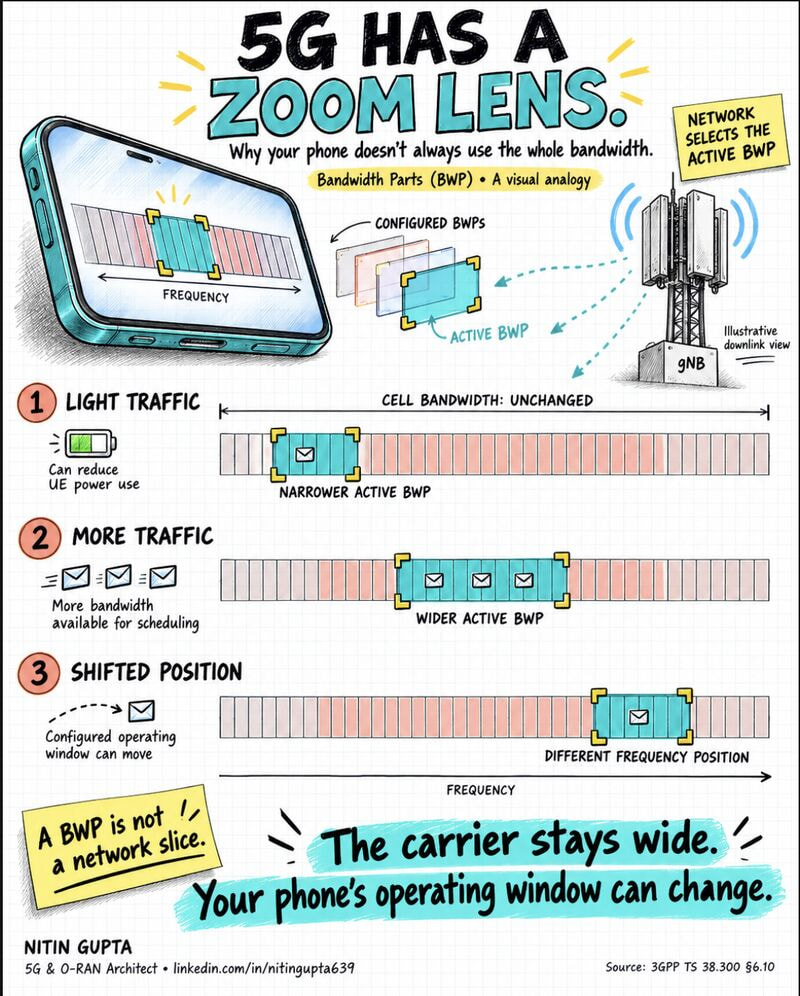
Think of a BWP as an adjustable operating window inside the cell’s bandwidth.
⠀
The “zoom lens” in this illustration is an analogy. The network is changing the phone’s operating window, not focusing an antenna beam.
⠀
Here is what that enables:⠀
- Narrower window
- During low activity, a narrower active BWP can help reduce the phone’s power consumption.
⠀
- During low activity, a narrower active BWP can help reduce the phone’s power consumption.
- Wider window
- A wider active BWP makes more bandwidth available for scheduling when needed.
⠀
- A wider active BWP makes more bandwidth available for scheduling when needed.
- Different position
- The active window can move to a different frequency position by switching between configured BWPs.
In these examples, the cell bandwidth stays unchanged.
The UE’s active operating window changes.
⠀
Two distinctions matter:
⠀
➜ A BWP is NOT a network slice.
➜ A wider BWP does NOT guarantee higher throughput.
⠀
The active BWP defines an operating range. It does not mean every resource inside that range is allocated to your phone.
⠀
Actual performance still depends on scheduling, radio conditions, network load and device capability.
⠀
For telecom engineers, the lesson is simple:
⠀
Do not look only at the carrier bandwidth.
Understand the active BWP and what is being scheduled within it.
⠀
5G is not just about using more spectrum.
It is also about using the right operating bandwidth.
LinkedIn: 